.comment-link {margin-left:.6em;}

Nominal Me

I'm falling in love with my camera and taking photos everywhere I go. That, combined with my passions for politics, sports, religion and other things we all agree on, makes this blog persist.


Monday, October 20, 2008

This Was Fun, But...

...it's time to phase out this blog. When I started it, I really thought I would have the time to write thoughtful and entertaining blog posts on a regular basis. Life, and my interests, have changed in the past year or so.

I'm much more interested in photography nowadays, and the blog format is not the best for that.

So my loyal readers, feel free to visit my photo page. I'll keep most of my galleries public and may write witty captions from time to time.

As for this blog, I'll be taking most of the stuff that's here down as I save it on my computer and transfer the photos to my gallery.

Thanks for the both of you who still read this thing!

Thursday, June 29, 2006

Aggieland

Fate had me spend my 34th birthday in College Station, TX, home of Texas A&M University. Here are some photos of my visit there. The city is in the middle of nowhere in Texas, and getting there from Dallas made for a peaceful drive.

Student advisors were getting ready for school orientation, which one former alumnus I know described it as a "long brainwashing process where they teach you about Texas A&M history and traditions."

My co-workers and I ate at the "Country Inn & Restaurant". It took us nearly 45 minutes to get there from College Station. My co-worker, who is a Texas A&M alumnus, seemed disappointed in the place. It was not nearly as good as he remembered it as a student. There seemed to be two reasons for this: 1) new ownership and higher prices, and 2) he wasn't in college anymore, and has since had good "adult" meals.

It was OK, but not a great place for a birthday meal.

The sign outside of the restaurant said "C O ED MON : TUE. V TED 1 Hi K N F i D EAT AS EXST" I have no idea what this means. I think you have to be a drunk college student to figure it out.

College Station is home to what are known as "Love Bugs", which apparently are not bugs at all. These are two bugs that are walking together having bug sex right in the middle of the sidewalk.

Apparently, humans do not seem to love them all that much.

They are all over the place, just banging each other and doing their business in public. This led me to believe that the college students here probably do the same when school is in session. Man, I really should have gone here instead of Hartwick College.

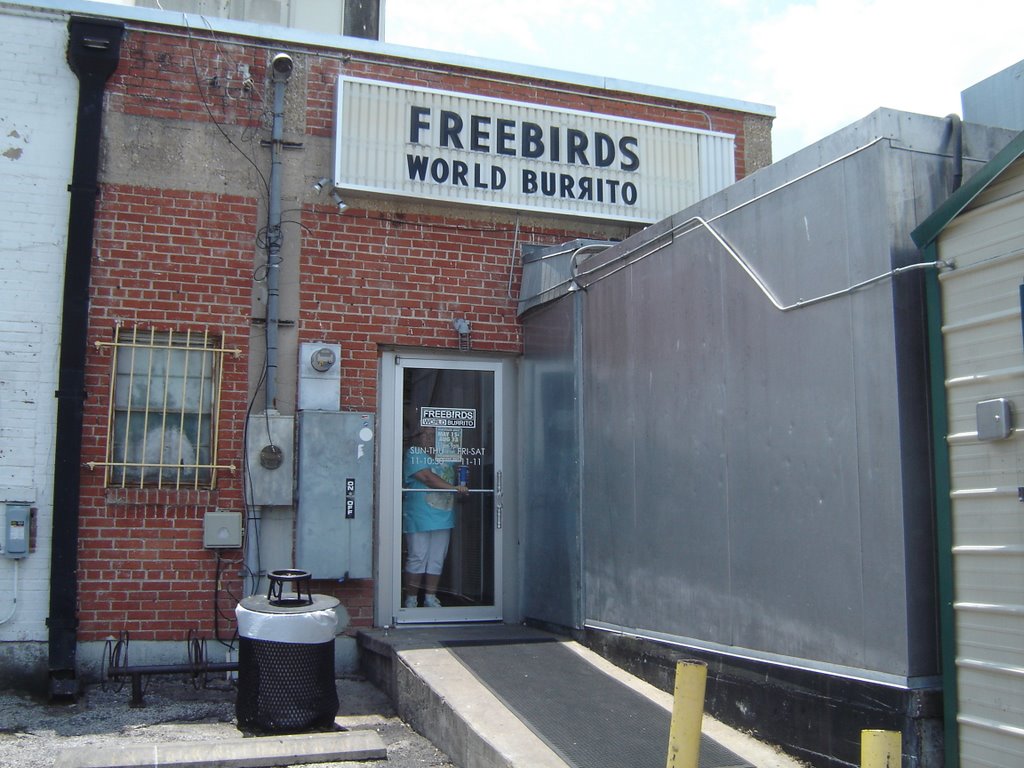
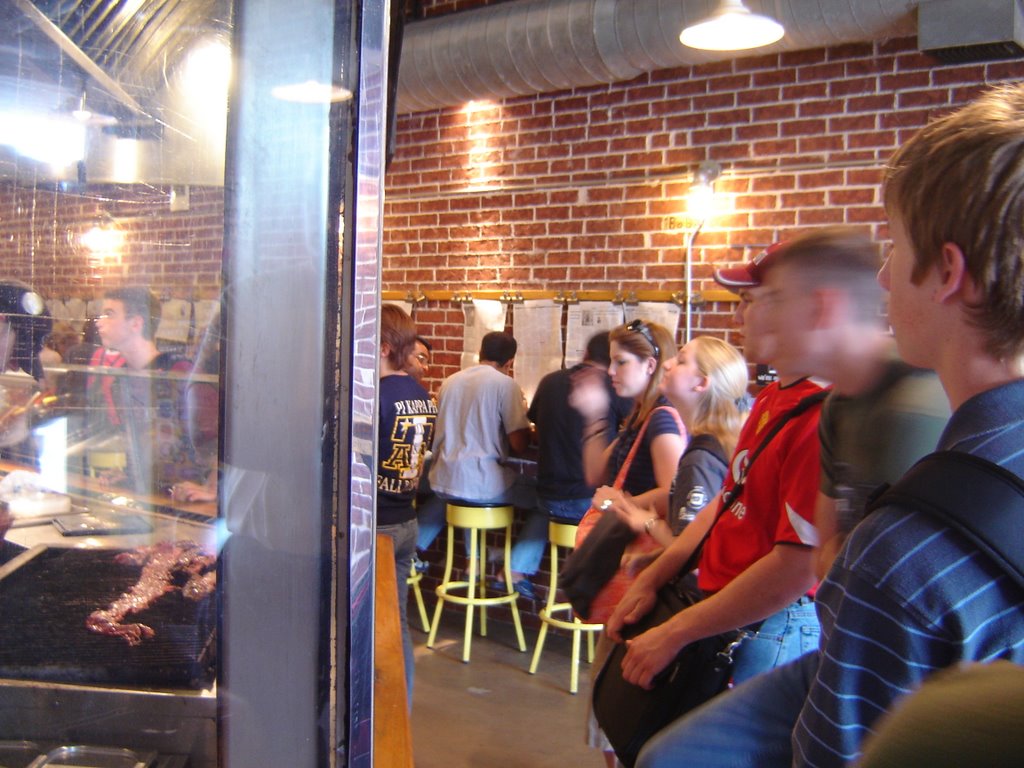
One suggestion that he did have that was awesome was "Freebirds World Burrito," which was apparently founded here in College Station. It is sort of like Chipotle, without the corporate sponsorship.

The place was packed.

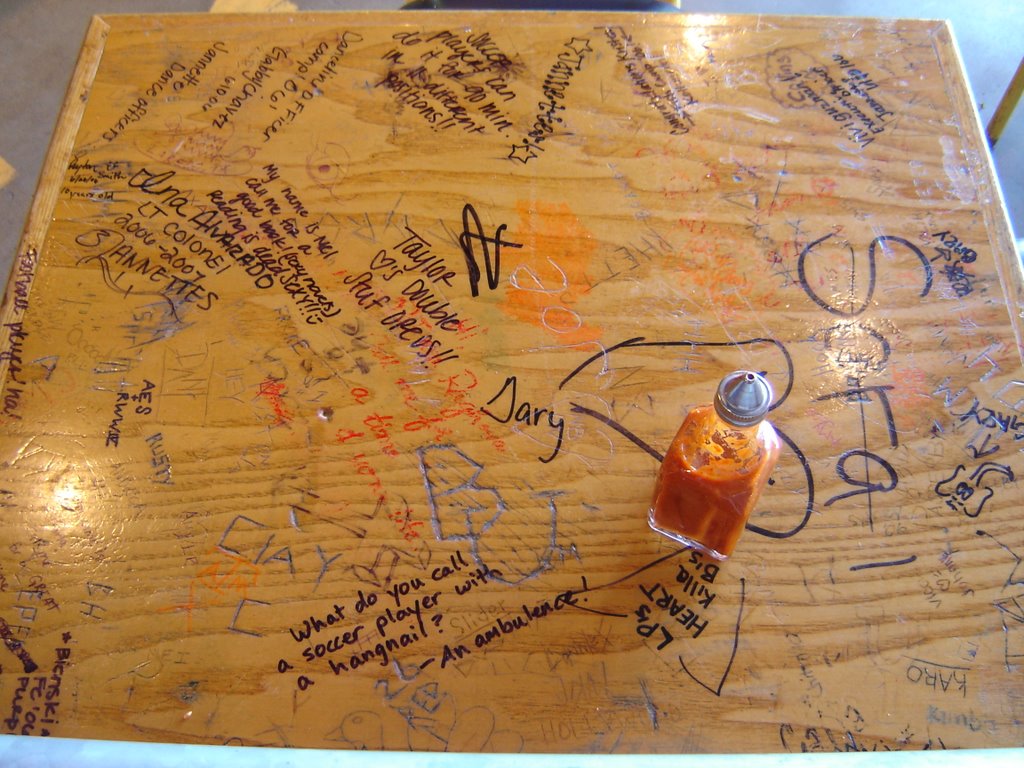
Although signs asked people not to write on the furniture, people did anyway.

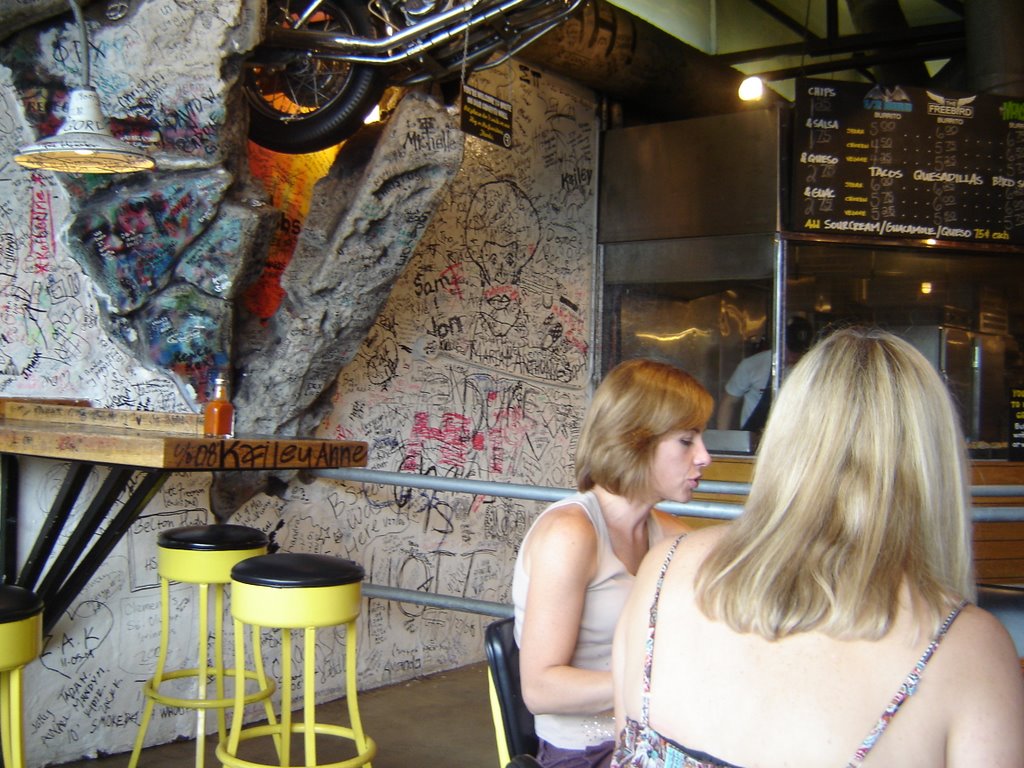
Writing on the walls was OK.

In fact, it was encouraged.

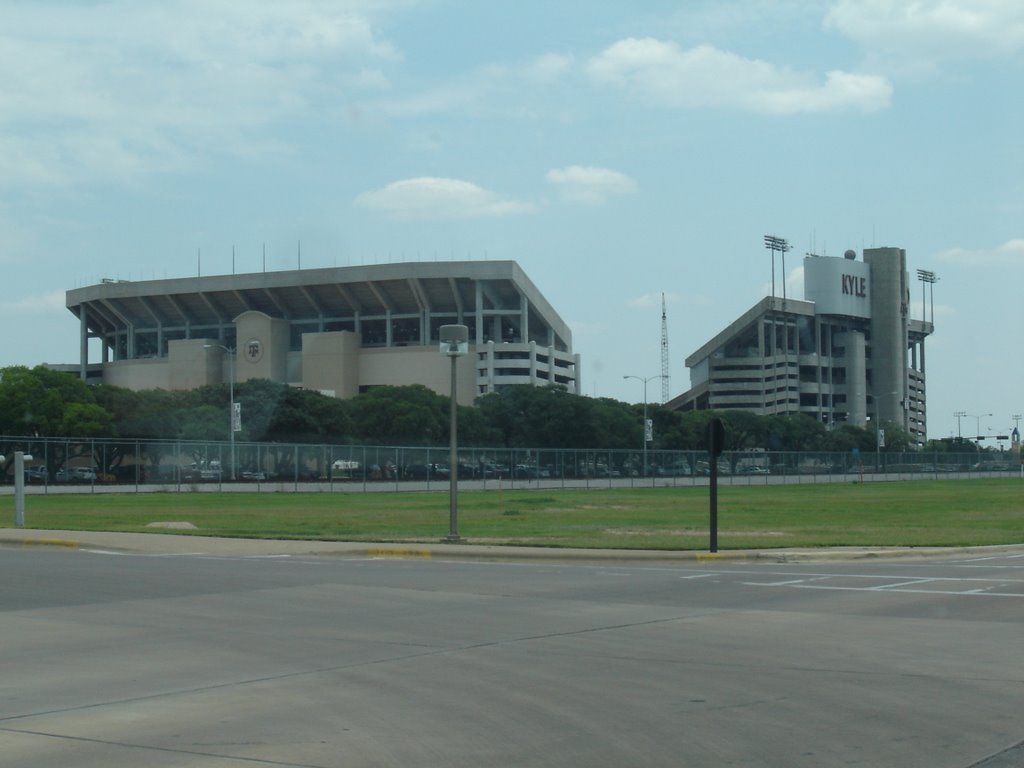
This is Kyle Field, home of the Division I-A Texas A&M Aggie football team. In the days when I was unemployed and had all the time in the world to play the PS2 version of NCAA Football, I once took this university to six consecutive national championships.

It was nice to see the area that I once had so much success at in a more tangible manner. It is a good sized football stadium (82,600 capacity) and has a great tradition around it. It was built in 1927 and 1929 and named after a former dean of agriculture.

This is the Texas A&M practice field, which is covered up during football season to avoid spying.

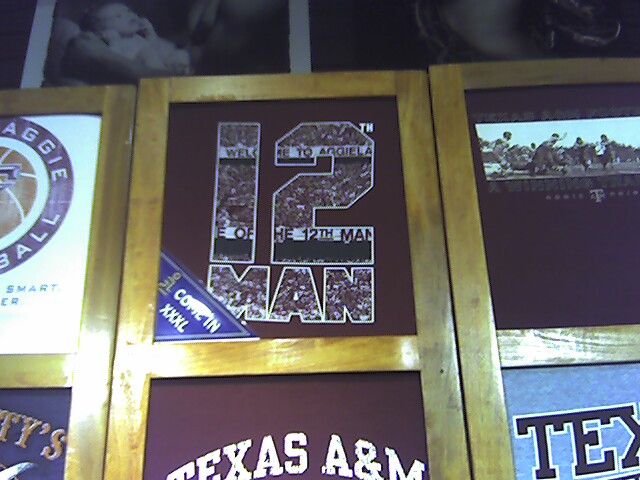
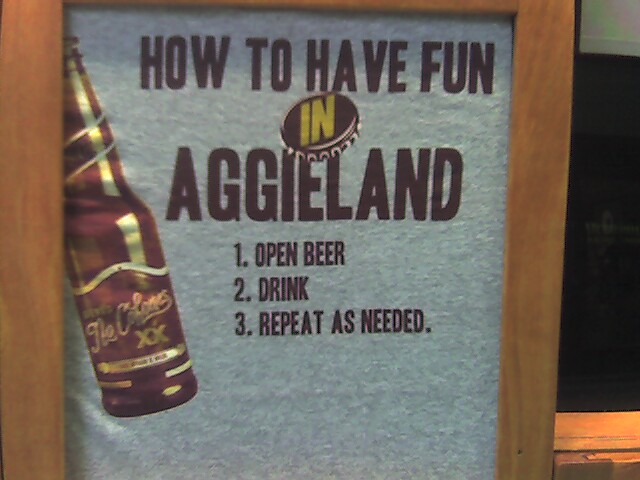
I stopped by a t-shirt store in a local mall to see what the college students are wearing. Apparently, beer is on their mind when it comes to their education. Shocking.

Texas A&M is the legal home of the 12th man, according to a lawsuit filed against the Seattle Seahawks. Students here use creative t-shirts as a way to express their emotions...and ego...about football and other subjects. Why they have this stuck up their buttocks is explained here.

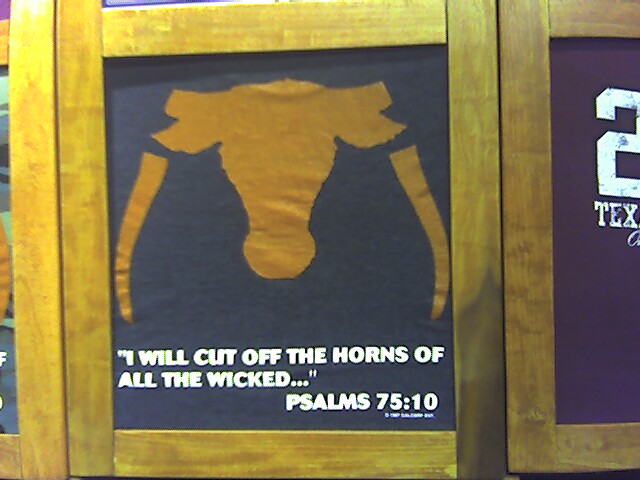
Football passion runs wild here, and so do football rivalries. The University of Texas (a much nicer campus I visited, by the way) is hated here, and apparently God does not like UT. Here is a creative use of Psalm 75:10, "I will cut off the horns of all the wicked..." I'm not sure about the theology of this one, but what can you expect from a college town?

After they cut off the horns of Texas' cow, they plan to eat it. This is not a friendly place to be UT fan.

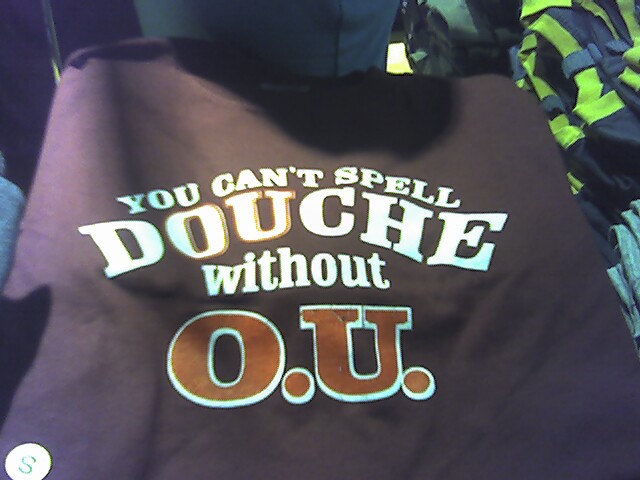
They don't just hate the University of Texas here, they also extremely dislike Oklahoma University.

Texas Tech gets no love here either, although no one really takes Texas Tech seriously enough to complain about them very much.

There is a natural order of things here, and it involves overlooking Texas winning the national championship last year.

Here's how to have fun in Aggieland.

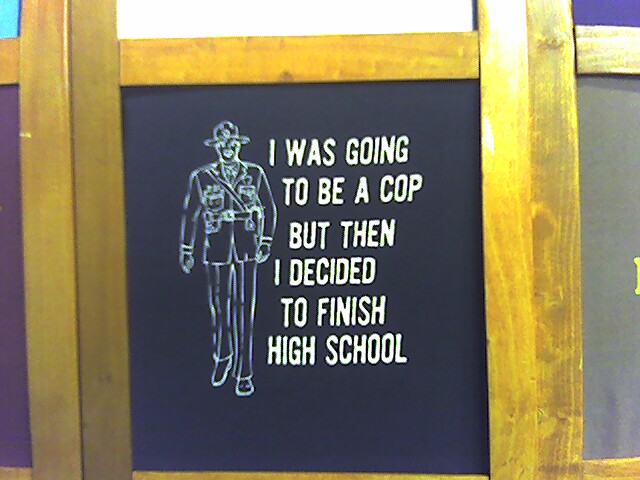
So much for respecting the law here in College Station.

College Station seems to be a fun town. It's too bad I was just driving through, as it has a lot of spirit. Perhaps I'll come back here someday.

The George Bush Presidential Library

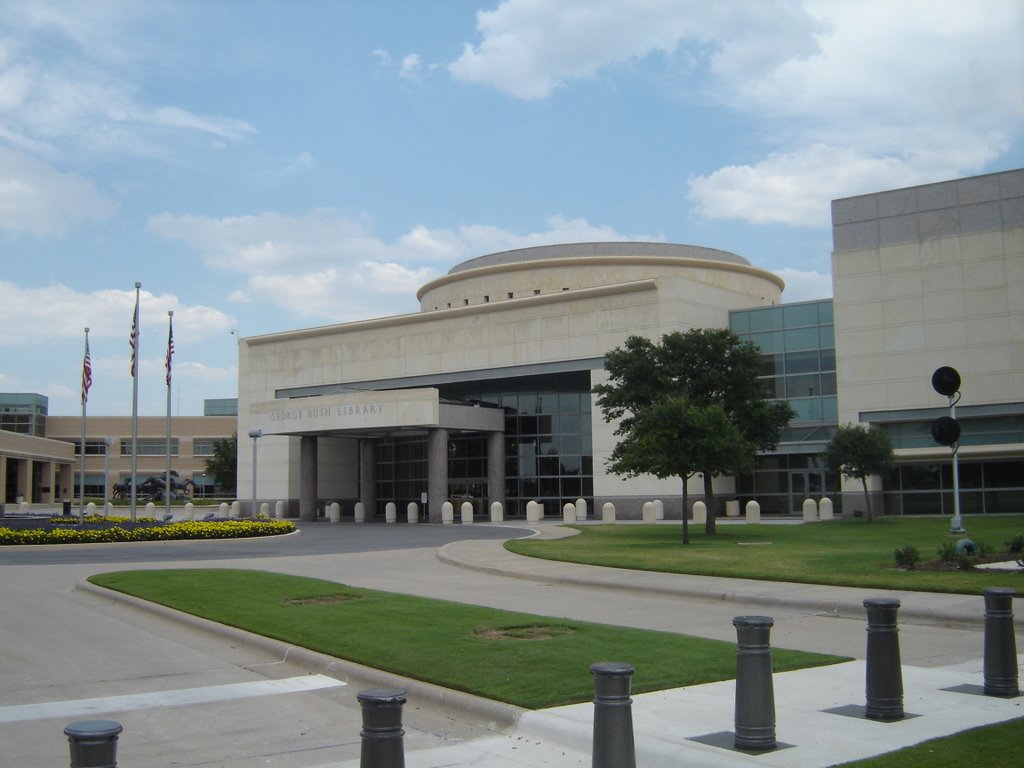
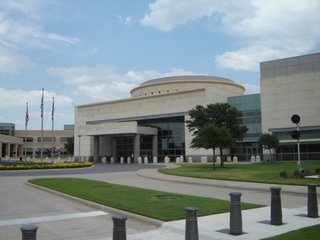
On my 34th birthday I spent some free time at the George Bush Presidential Library, which is located on the campus of Texas A&M University in College Station, TX. It is the seventh Presidential library and museum I've been to thus far (Hoover, FDR, Truman, Johnson, Nixon, and Reagan).
I was warmly greeted by a volunteer, telling me what I could see inside. I don't believe any of the libraries I've been to do this.
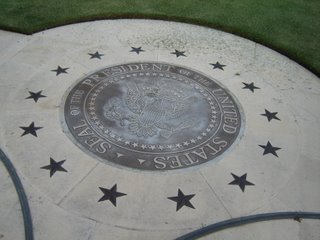
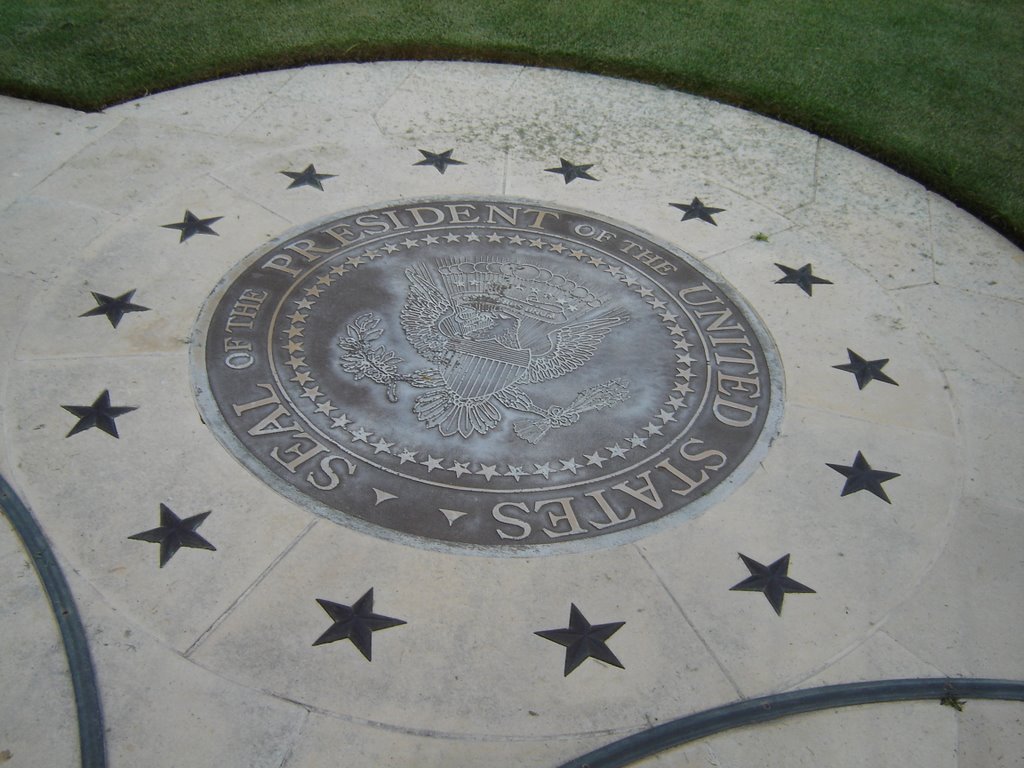
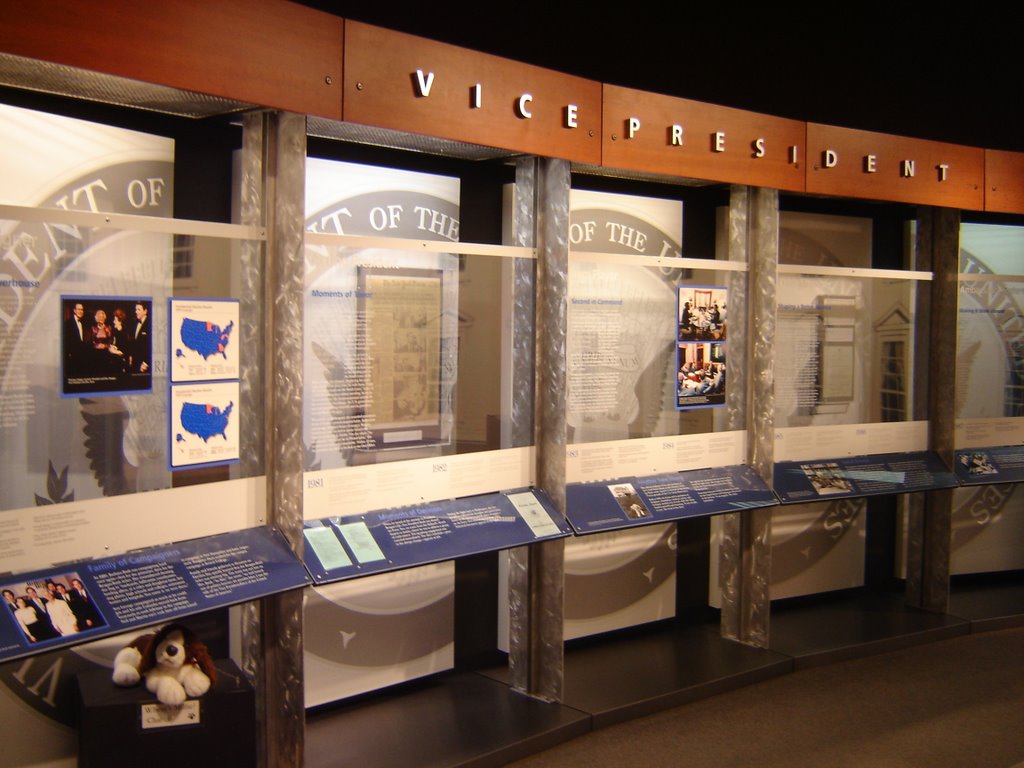
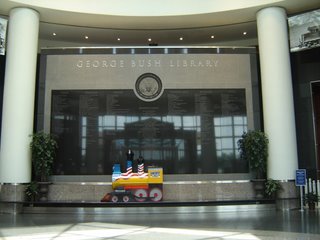
The lobby has the presidential seal in marble.
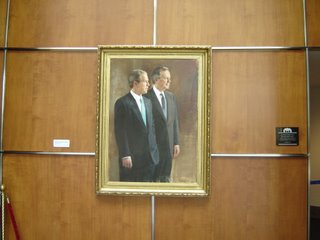
The Bush legacy is subtly represented in the lobby, with the subject of the library being in the foreground.
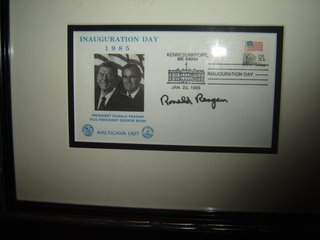
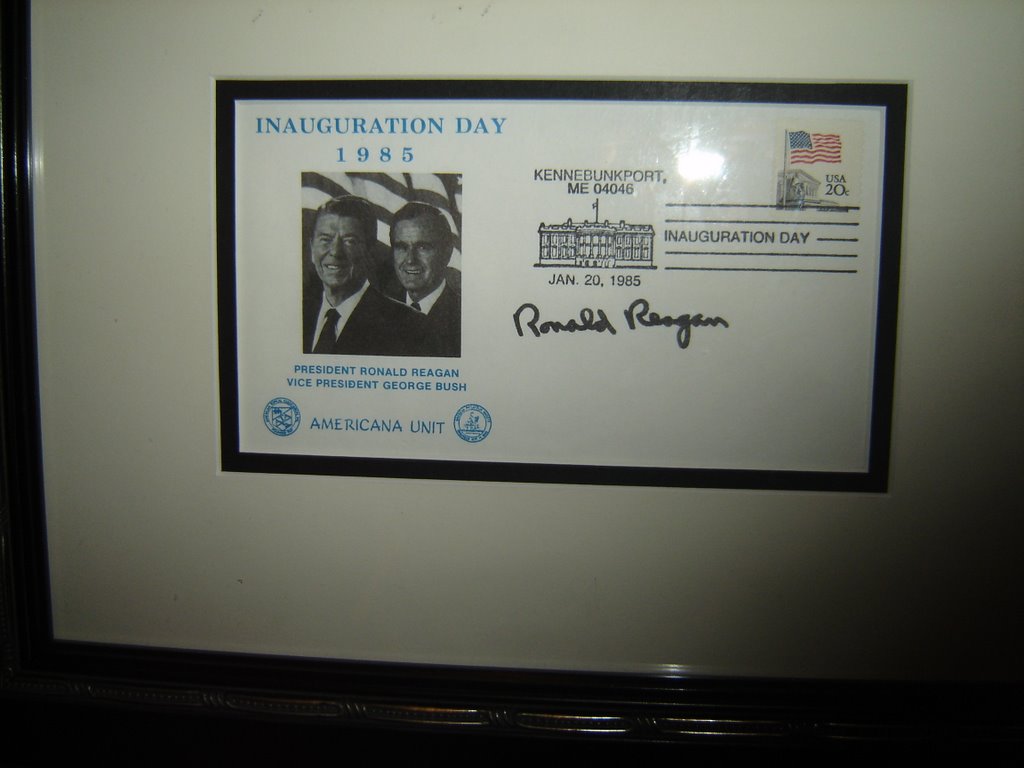
In one room, the signatures of various U.S. presidents are on display. It was interesting to note that only Ronald Reagan's had a slant to the left, signifying creativity over organization (although there are other graphology theories relating to a left slant).
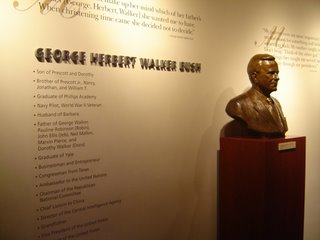
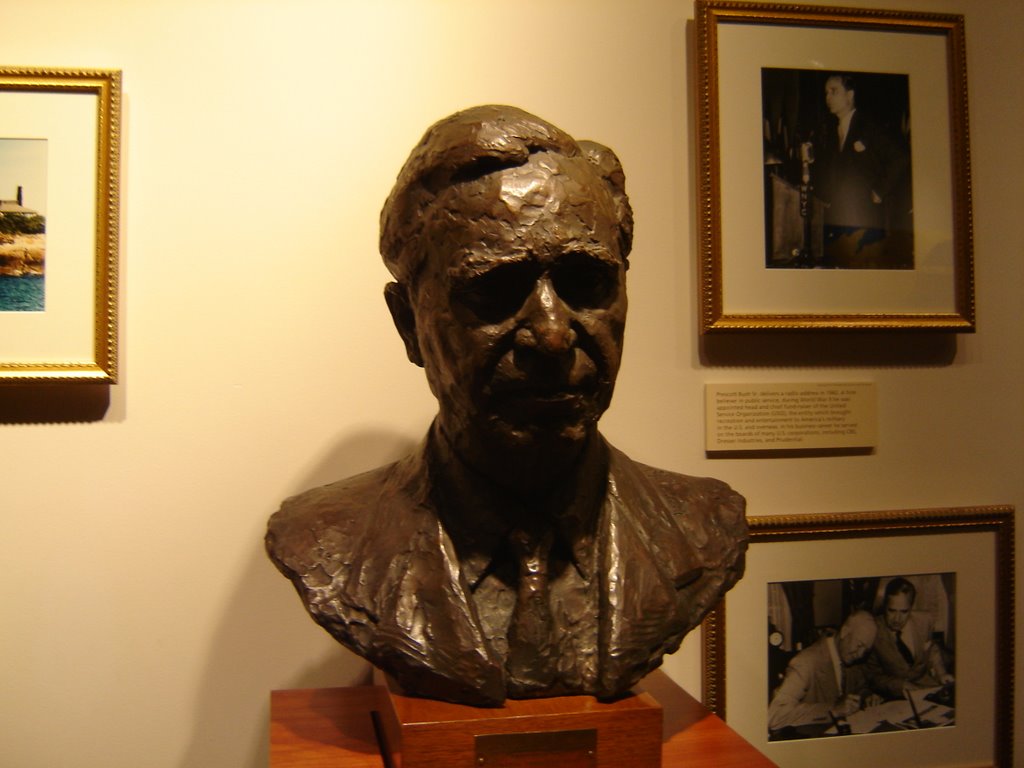
The museum exhibit begins with a bust of George Herbert Walker Bush, the 41st President of the United States. Bush is described here as many things, ranging from a son to a president to a citizen.
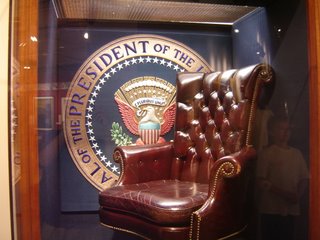
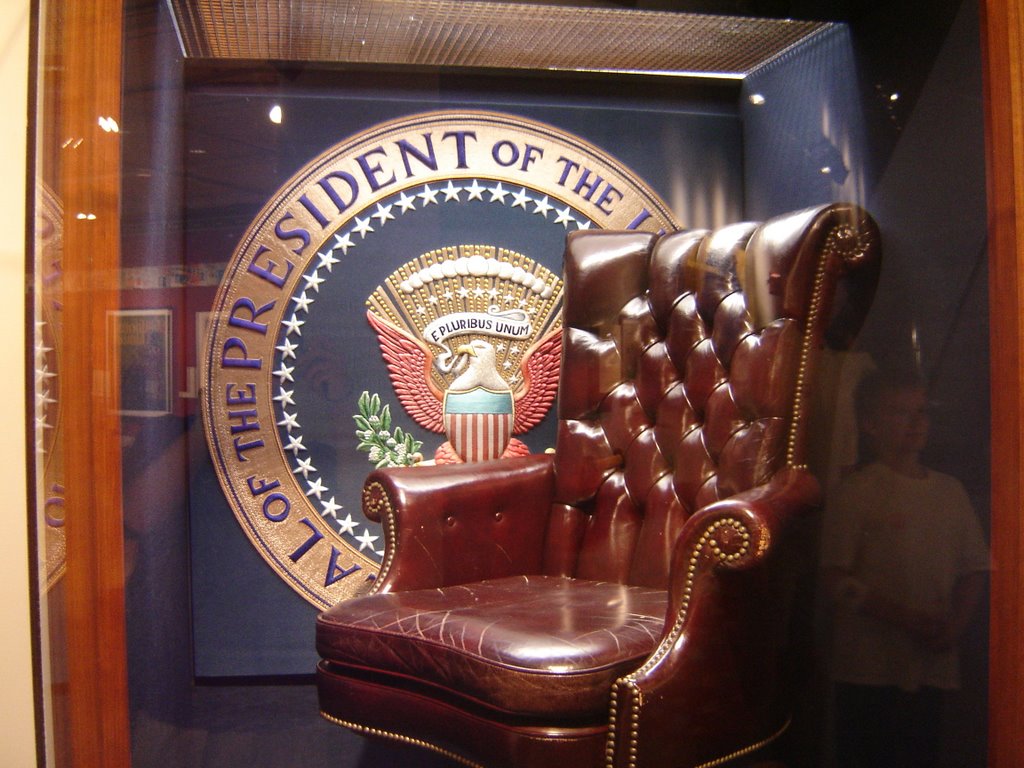
This was Bush's seat while serving as president.
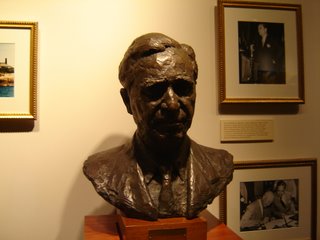
Bush's father, Prescott, served in the U.S. Senate. He represented the state of Connecticut from 1953 to 1963. His son George would be born in Milton, Massachusetts, on June 12, 1924.
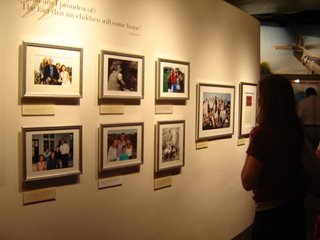
The former president always seemed to be a humble man, which is why it seem poignant to me that his family would get the first billing in his library.
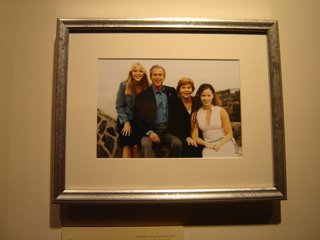
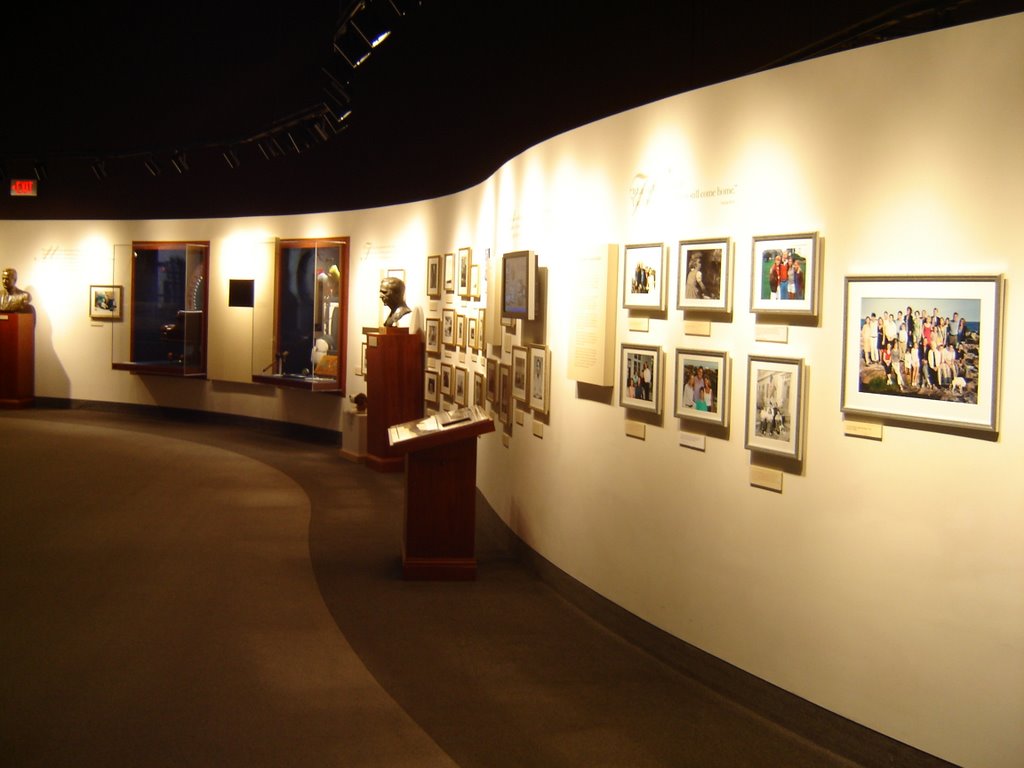
Each one of Bush's children have photos on display.
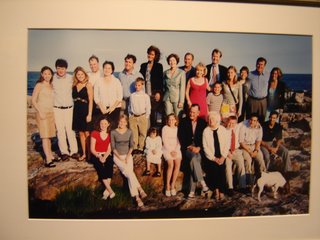
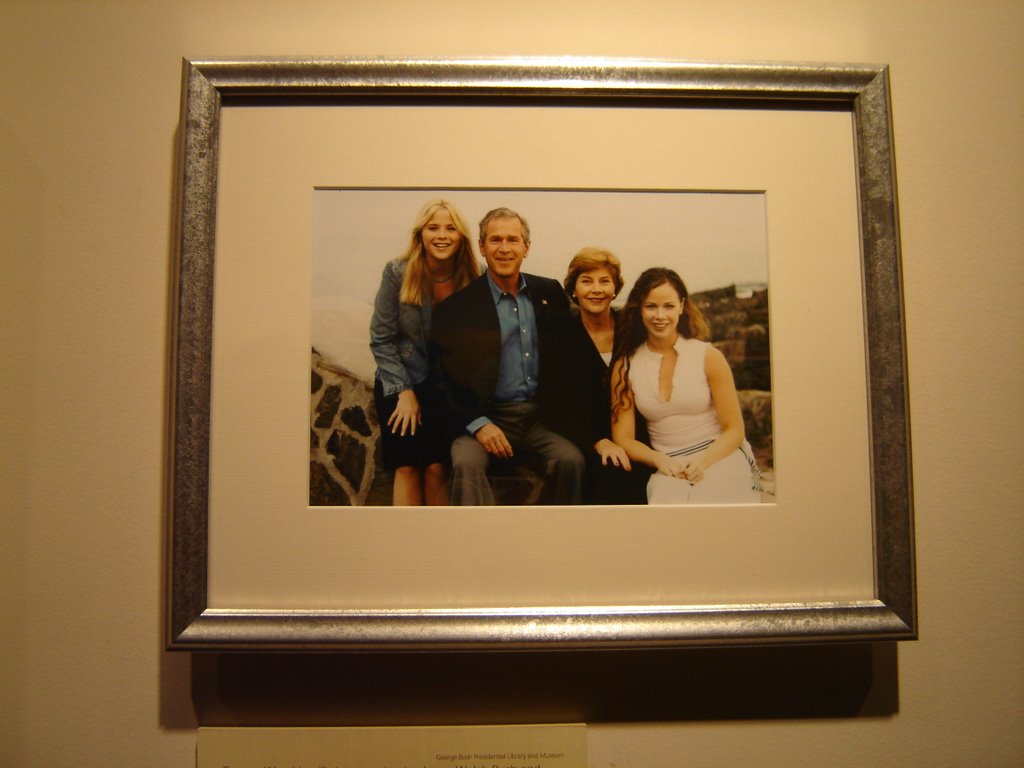
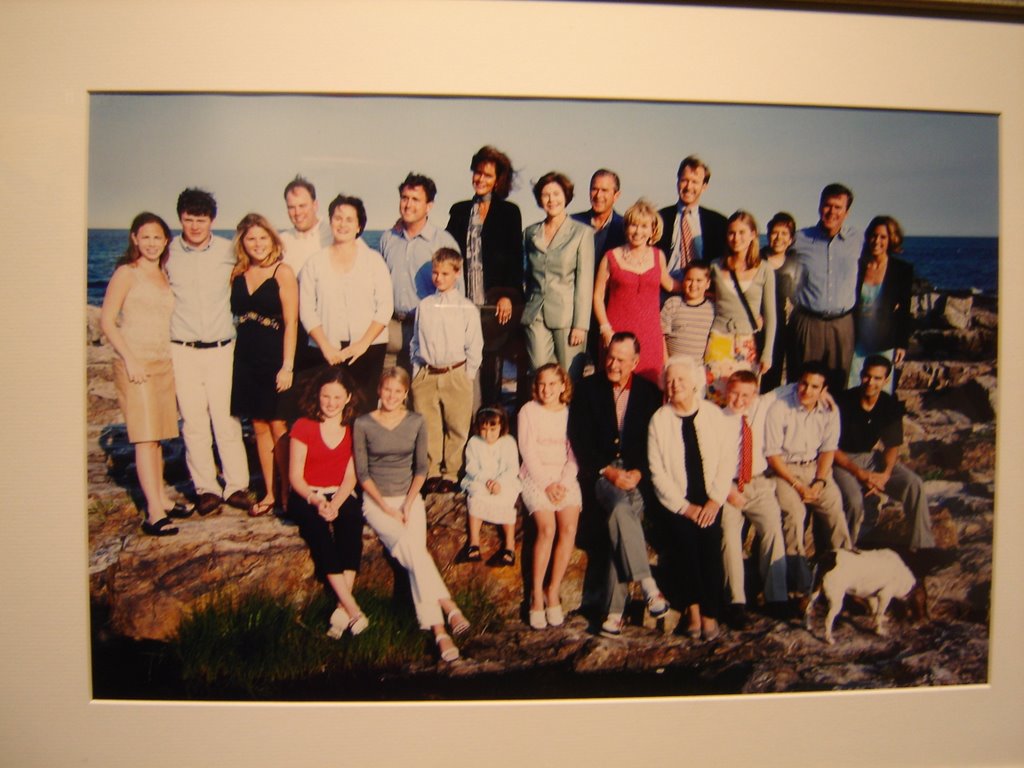
One photo of the larger clan, taken in Kennebunkport, ME in 2000, is also hung up.
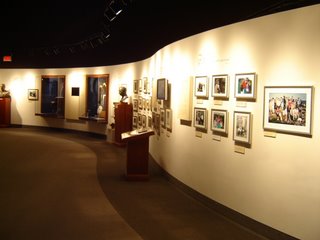
The area of the museum seemed so warm and friendly, with a very interesting design. Right off the bat, I knew this was one of the better presidential libraries.
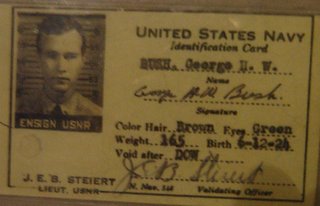
George H.W. Bush served in the U.S. Navy as a bomber pilot in World War II -- signing up on his 18th birthday -- and was shot down by Japanese forces at one point (due to his actions in completing his mission despite difficult odds, he was given the Distinguished Flying Cross). Here is the identification card he was given as an Ensign. At the Davenport, IA air show, I would see the kind of plane Bush piloted. Bush would fly in 58 combat missions during the war.
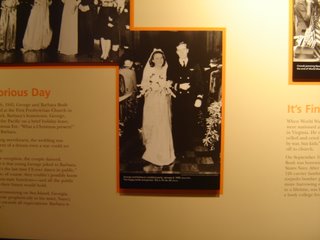
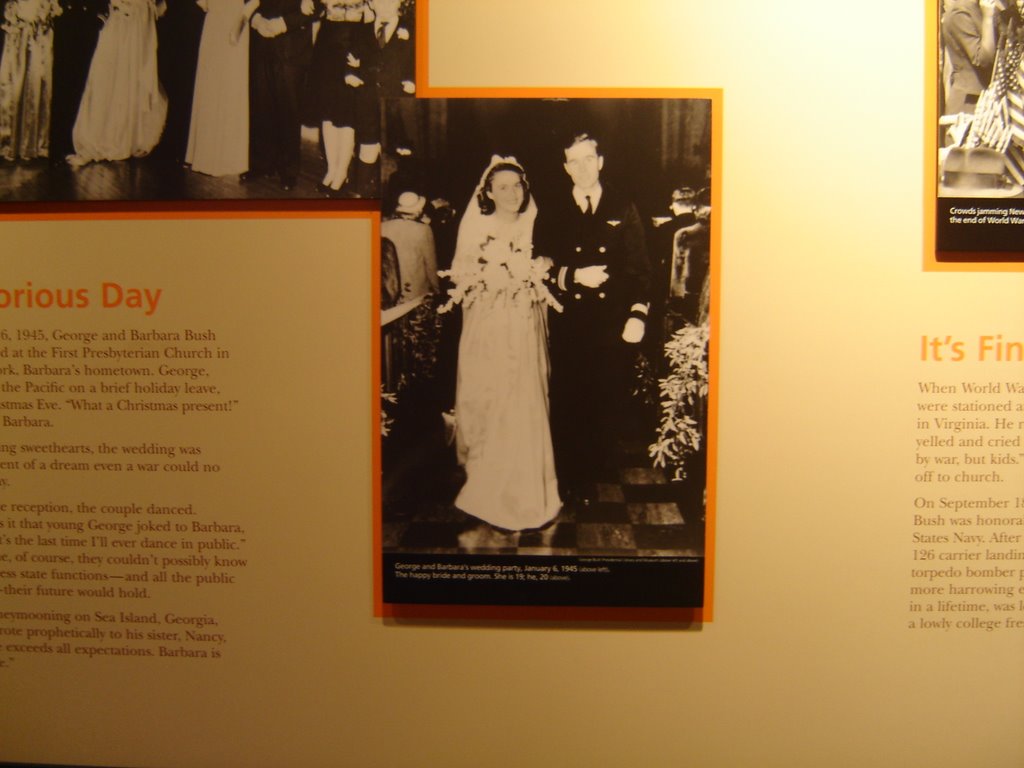
Bush would marry Barbara Pierce on January 6, 1945 while still in the Navy. They would wed at First Presbyterian Church in Rye, NY.
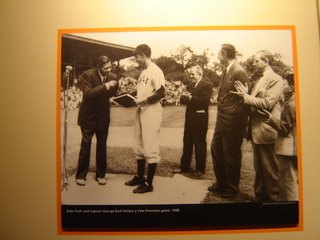
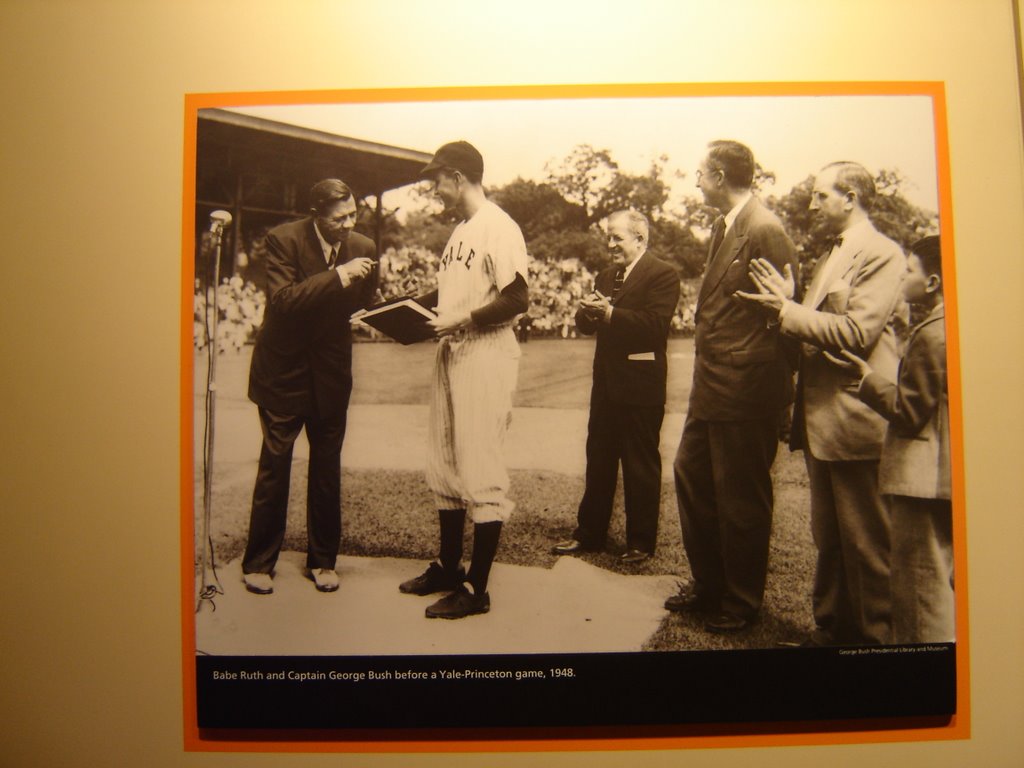
After the war, Bush would attend Yale University. He would serve as captain of the baseball and soccer teams, become president of his chapter of the Delta Kappa Epsilon fraternity, and join Phi Beta Kappa, the national honors society. While captain of his baseball team, he would meet the great Babe Ruth and play in the first College World Series.
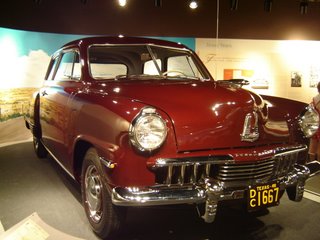
After graduating college, Bush would drive to Texas and try to become an entrepreneur in the oil business.
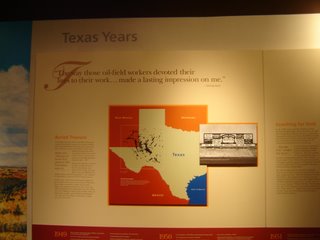
He would find himself in West Texas, living in Midland, TX where I once ate a really fantastic meal. It's also near the second largest meteor crater in America, located in Odessa, TX (lately, my life has been one big circle). He and others would create Zapata Oil which would have some moderate success.
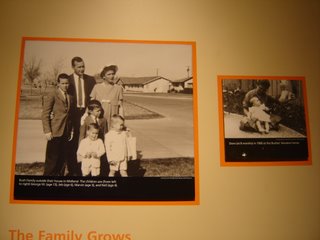
In the coming years, the Bush family would grow. George and Barbara would have six children: George W. (the future president), Pauline Robinson ("Robin", who would die of leukemia at four years old), John (Jeb, who would become governor of Florida), Neil, Marvin, and Dorothy Walker.
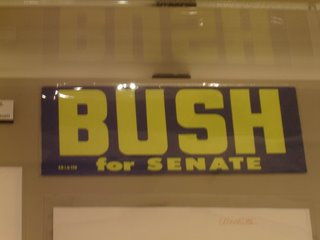
As a successful businessman, Bush would be asked to run the then non-existent local Republican party. In 1964, Bush ran for the U.S. Senate and lost in what was a heavily Democratic state in a year that GOP candidate Barry Goldwater was demolished by Lyndon Johnson.
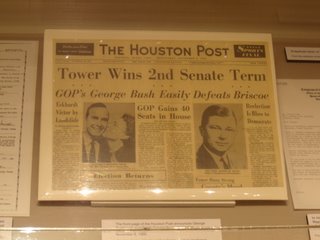
Bush elected in 1966 and 1968 to the House of Representatives from the 7th District of Texas, serving on the important House Ways and Means committee. In 1970, future Secretary of State James A. Baker would manage Bush's second campaign for the United States Senate, in which he would lose to Democrat (and future Vice Presidential candidate against him) Lloyd Bentsen.

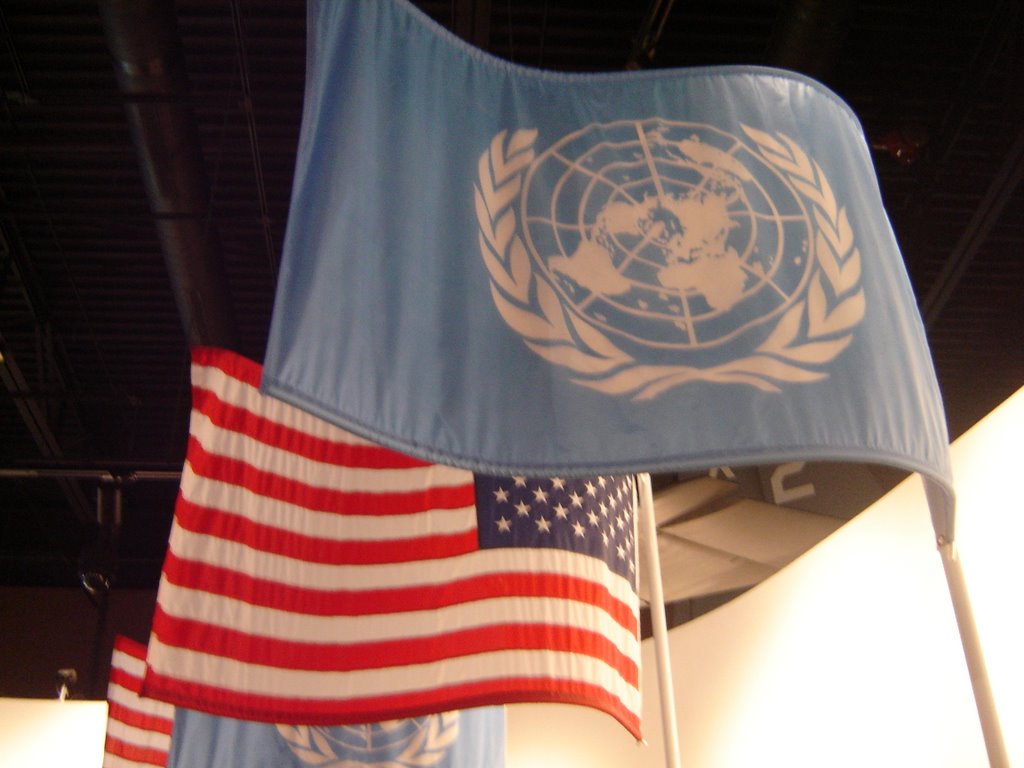
In 1971, President Nixon would appoint Bush to be the Ambassador to the United Nations, a cabinet-level post.
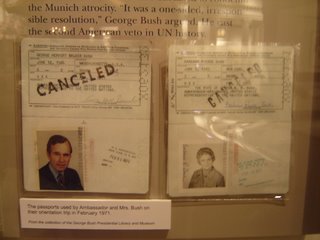
In this role, Bush would develop the skills and experience that would make him a strong advocate for American interests overseas. He'd also get some good use out of his passport.
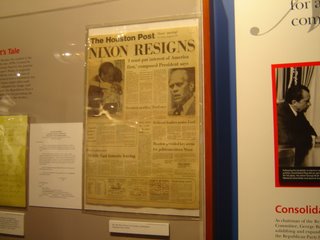
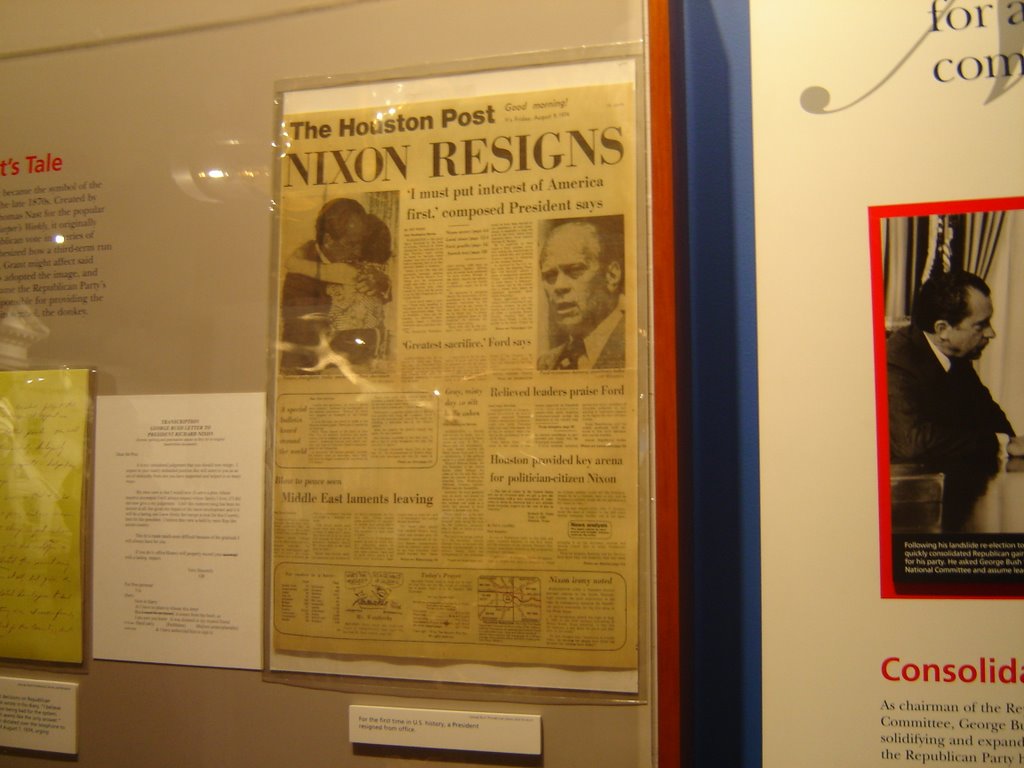
After Nixon was re-elected, Bush was asked to chair the Republican National Committee. It would turn out to be a very tough assignment for the future President, as Nixon would resign in disgrace over the Watergate affair.
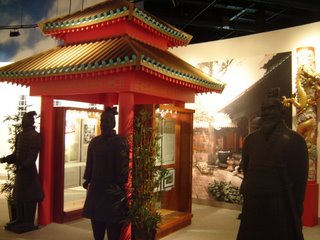
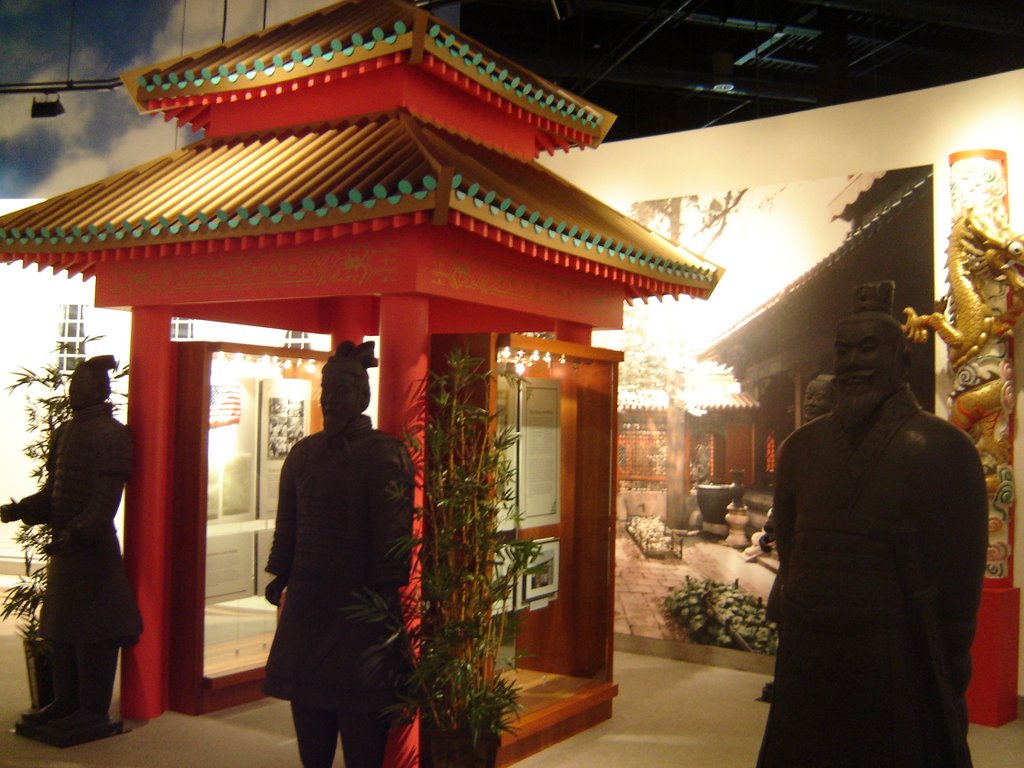
The new President Ford considered Bush for the office of Vice President, but went with New York Governor Nelson Rockefeller instead. Bush would be asked to be Chief of the U.S. Liaison office to China.
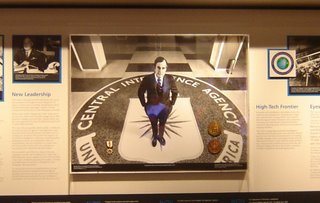
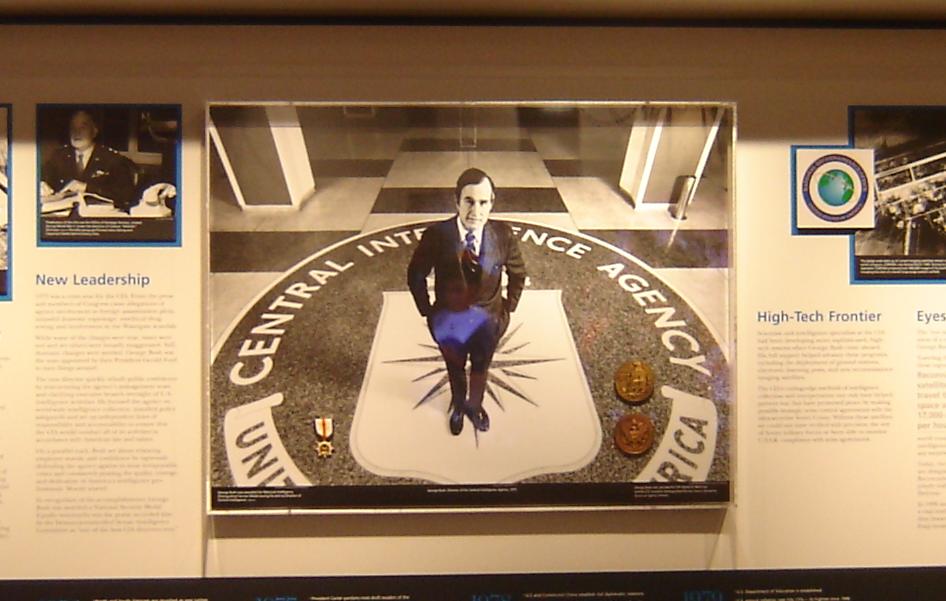
Soon after, on November 1, 1975, President Ford asked Bush to become the director of Central Intelligence.
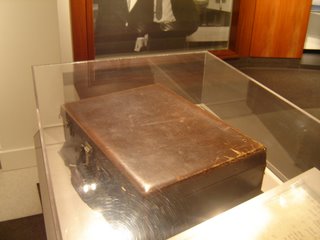
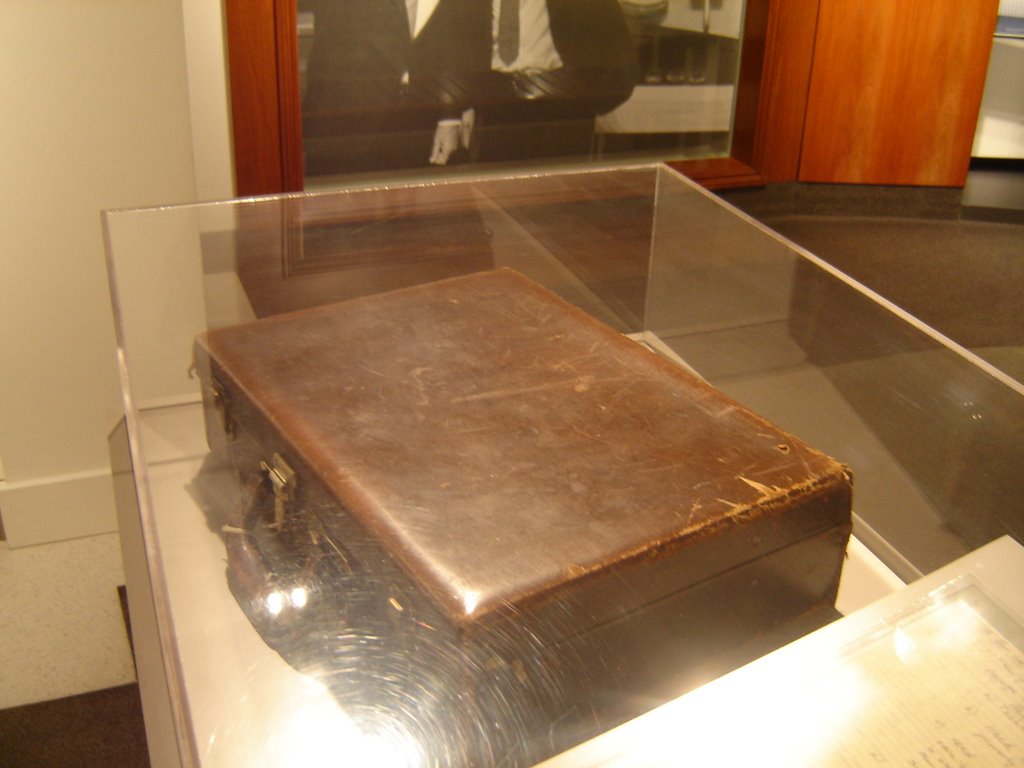
His briefcase, which held the greatest secrets our country had at the time, is on display.
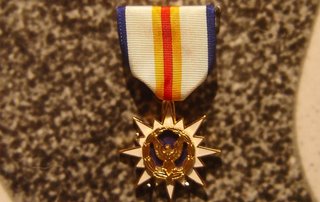

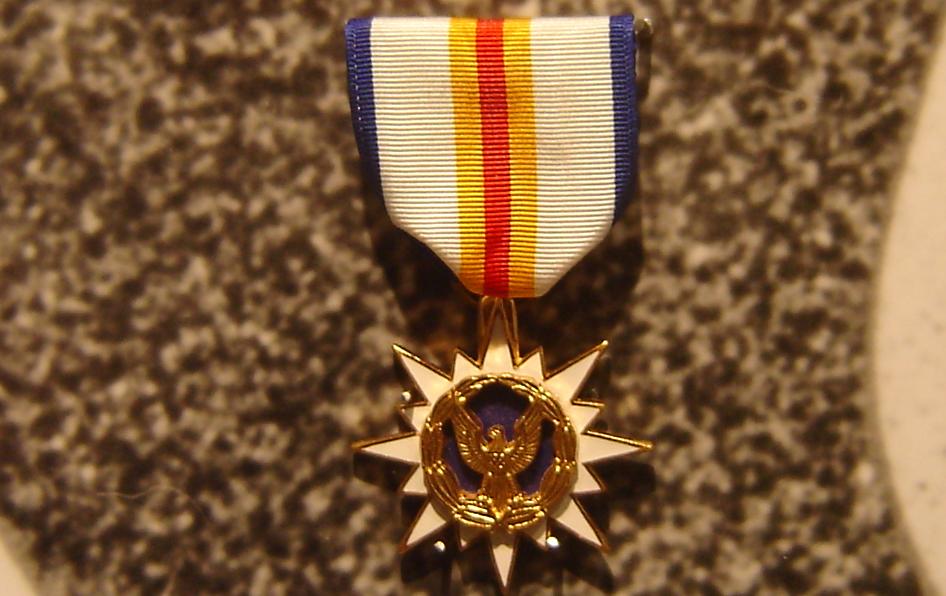
There, he would earn the National Intelligence Distinguished Service medal. Despite his honors, however, politics would ensure that Bush would not hold the post for very long.
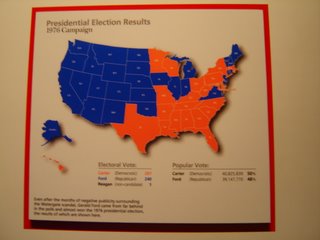
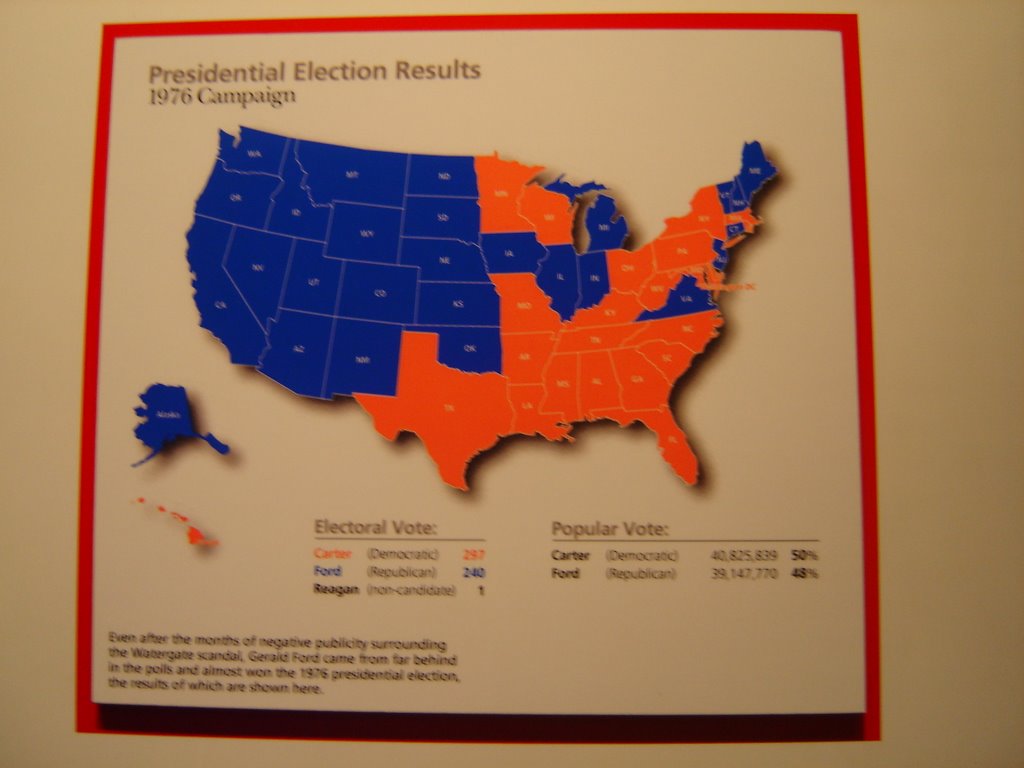
Then Republican President Ford would struggle hard against Democrat Jimmy Carter for re-election, but would lose much of the East and all of the South in an unsuccessful bid. With a Democrat in office as president, Bush would go on to work in the private sector.
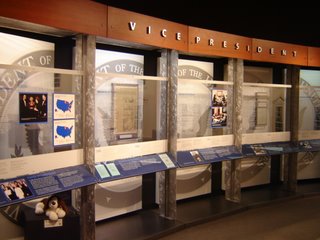
To many people's surprise, George H.W. Bush would announce his candidacy for President on May 1st, 1979 (my father's birthday). Bush would do much better than most people expected (and as the museum failed to note, at this time he coined the phrase "voodoo economics" that would plague President Reagan during his tenure). Bush would achieve an upset victory in Iowa, but it would be Reagan's year.

His campaign caught Reagan's attention, and leading up to the Republican convention he would call then Ambassador Bush and say:
"Hello George, this is Ron Reagan. I'd like to go over to the convention and announce that you're my choice for vice president...if that's alright with you."
The life of George H.W. Bush would never be the same.
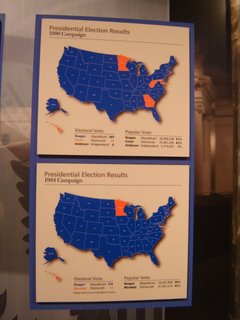
The Reagan/Bush ticket would win two national landslide elections. In 1984, the team would win more electoral votes than any other in American history.
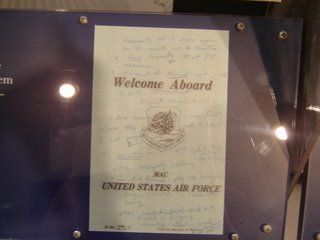
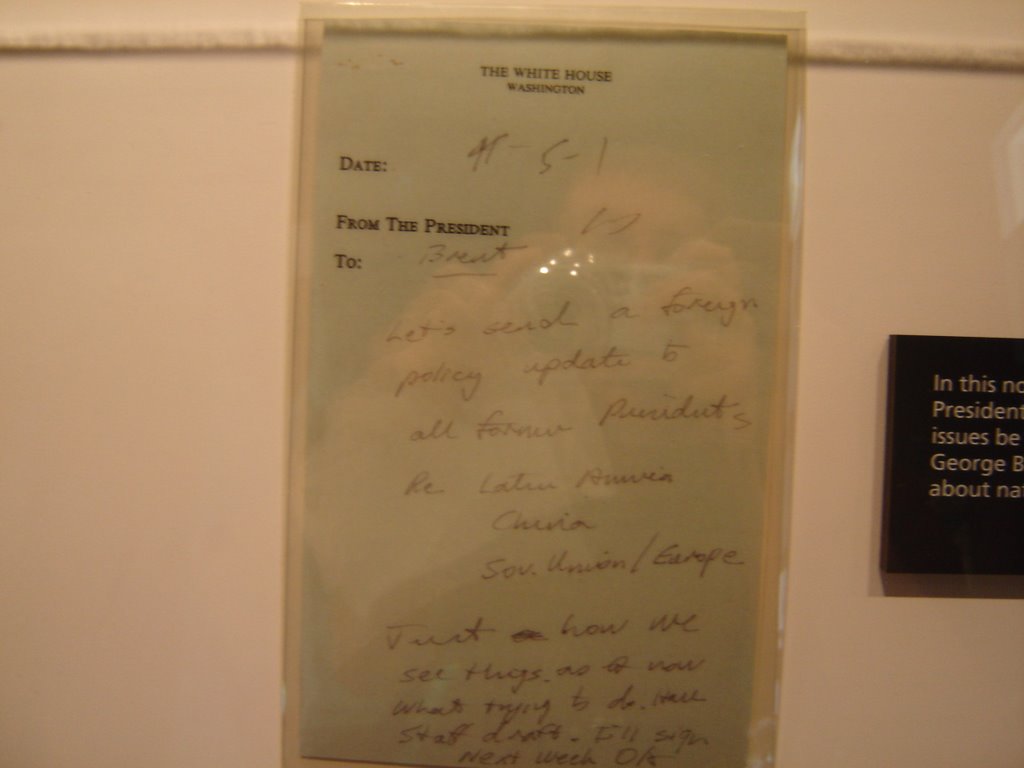
Soon after becoming Vice President, Ronald Reagan was shot. Bush was faced with the possibility of immediately being sworn in as the next President of the United States. While on Air Force Two going back to the White House, Bush would write on Air Force Stationary the thoughts on his mind. They included:
1. Enormity of it comes upon me. 20 minutes out of Austin.
2. Pray -- literally -- that R.R. recovers.
3. Element a friend, not just C. in C., President. Decent, warm, kind.
4. Not knowing.
5. Not fly -- intentionally, into S. Lawn.
Bush would discuss these comments, and others he wrote on this paper, with CBS News years later. They show the high character of a man in a very tense situation.
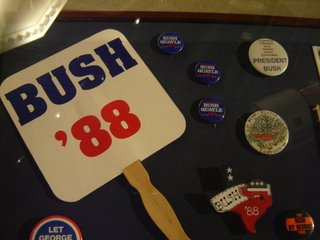
George Bush would run for President in 1988 and choice Indiana's junior senator, Dan Quayle, as his running mate.
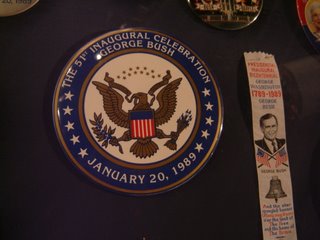
Campaigning on a theme of a "kinder and gentler nation," they would win and Bush would become our nation's 41st president.
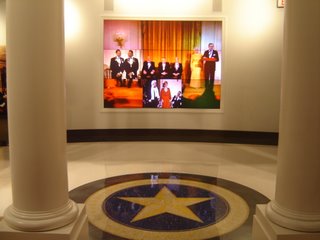
The museum covers his time in the White House in some depth.
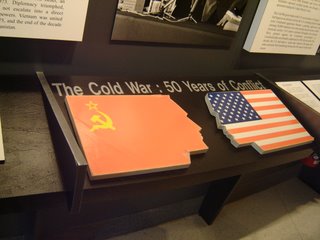
The President would be the last to serve under the Cold War. A piece of the Berlin wall is on display, appropriately enough, at the library of the American leader who was in office when it was brought down.
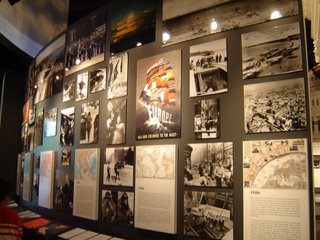
The era, from just after World War II until the early 90s is discussed using words, declassified documents, and photos.
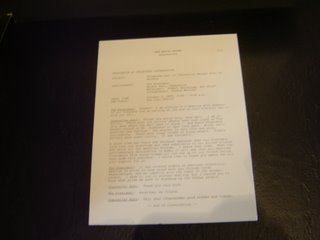
Documents on display, including comments from then German Chancellor Helmut Kohl, praise Bush's leadership and his place in the reunification of Germany.
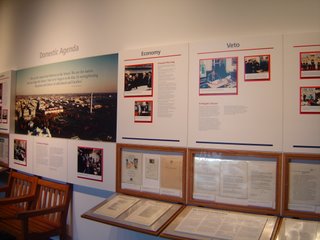
Bush's domestic agenda, an area where history does not often laud him in, is described in one section. They include the Americans with Disabilities Act (you can always tell a post-Bush-era elevator by it's large buttons located lower than most people would want them), the Clean Air Act (that is praised in Al Gore's "Inconvenient Truth" movie), other pro-environment moves, and the successful negotiation of NAFTA, the North American Free Trade Agreement, that President Bill Clinton would put through Congress.
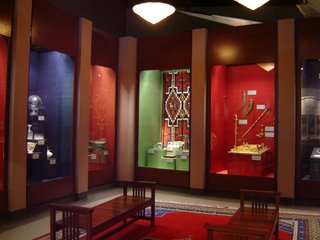
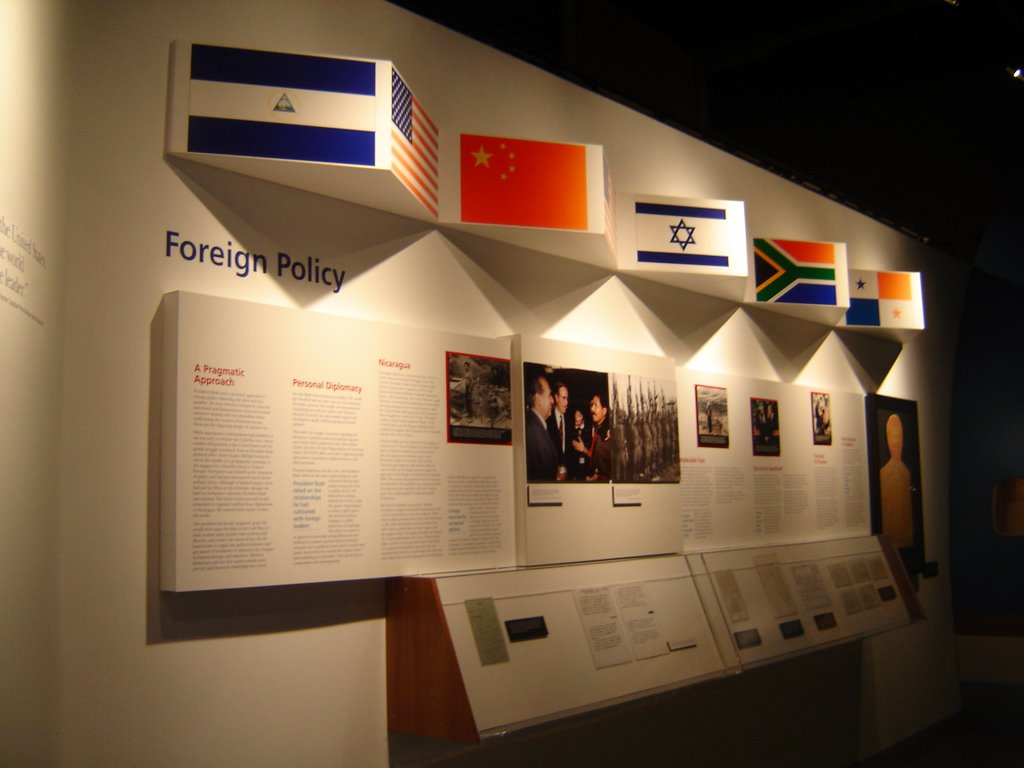
One section shows gifts from foreign governments.
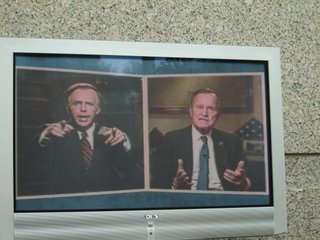
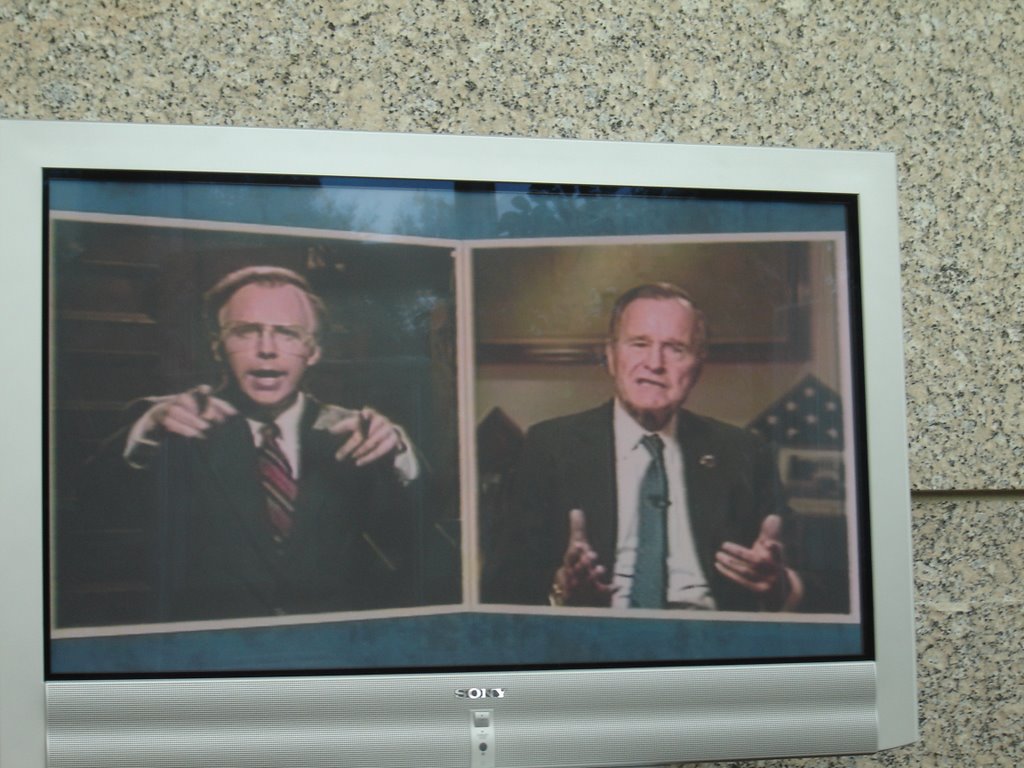
Here, Bush shows his personal side and humor. Some of the former President's funnier moments, including this Saturday Night Live skit with his imitator Dana Carvey, are shown to museum visitors.
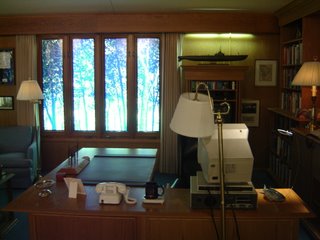
Like Herbert Hoover's Library, this one does not have a replica of the Oval Office. Instead, Bush's office at Camp David, his retreat center, is on display.
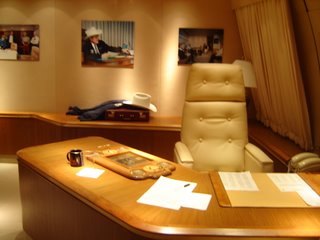
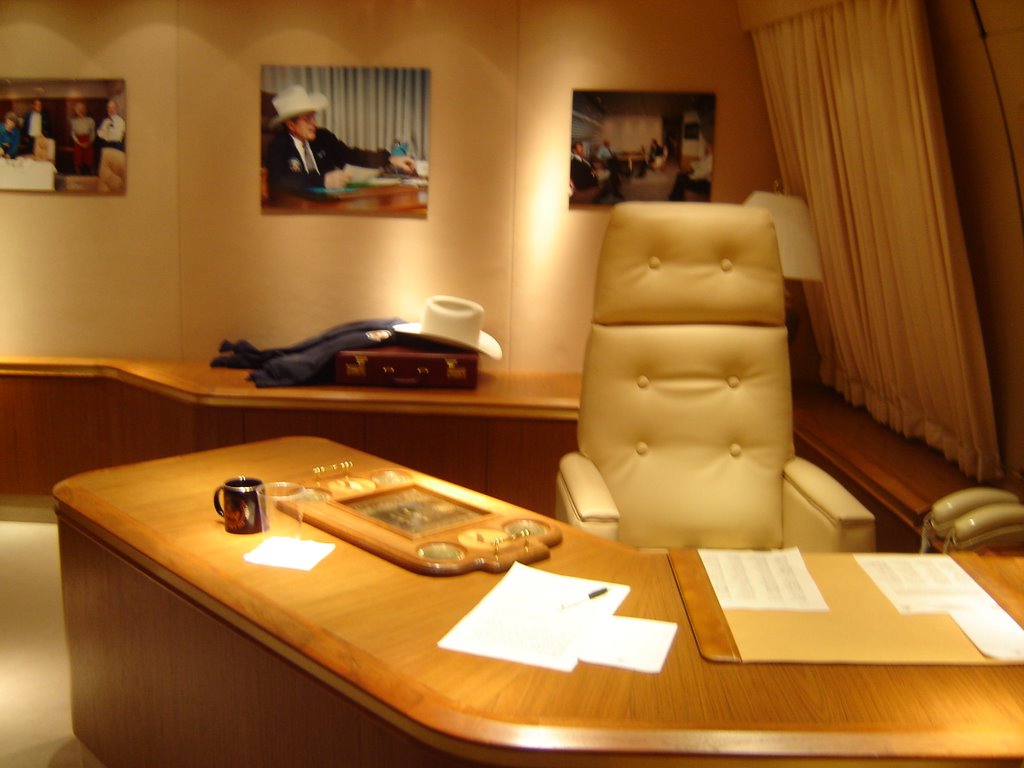
Also shown is a replica of Bush's Air Force One office. You may recall, from this blog, that the actual plane used by Ronald Reagan is in his library.

While Americans give #41 little credit on domestic affairs, he was known as a very skillful participant in foreign affairs. Then Canadian Prime Minister Brian Mulroney would say, "when George Bush was President of the United States, every single head of government in the world knew they were dealing with a genuine leader."

Bush would call on the personal relationships cultivated in the past for his foreign affairs work. For instance, President Bush would be the first foreign leader to call Nelson Mandela when he was released from prison. On a tougher note, Bush sent American troops into Panama to overthrow Panamanian leader General Manuel Noriega. Noriega was brought to the United States for trial as a drug trafficker.
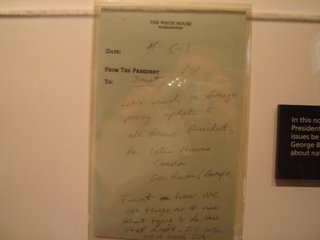
Bush would also show respect to his predecessors, allowing them to receive regular updates on intelligence and national security matters.
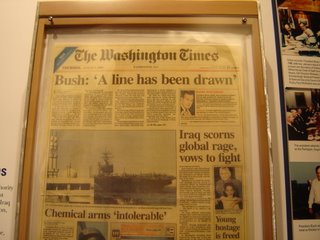
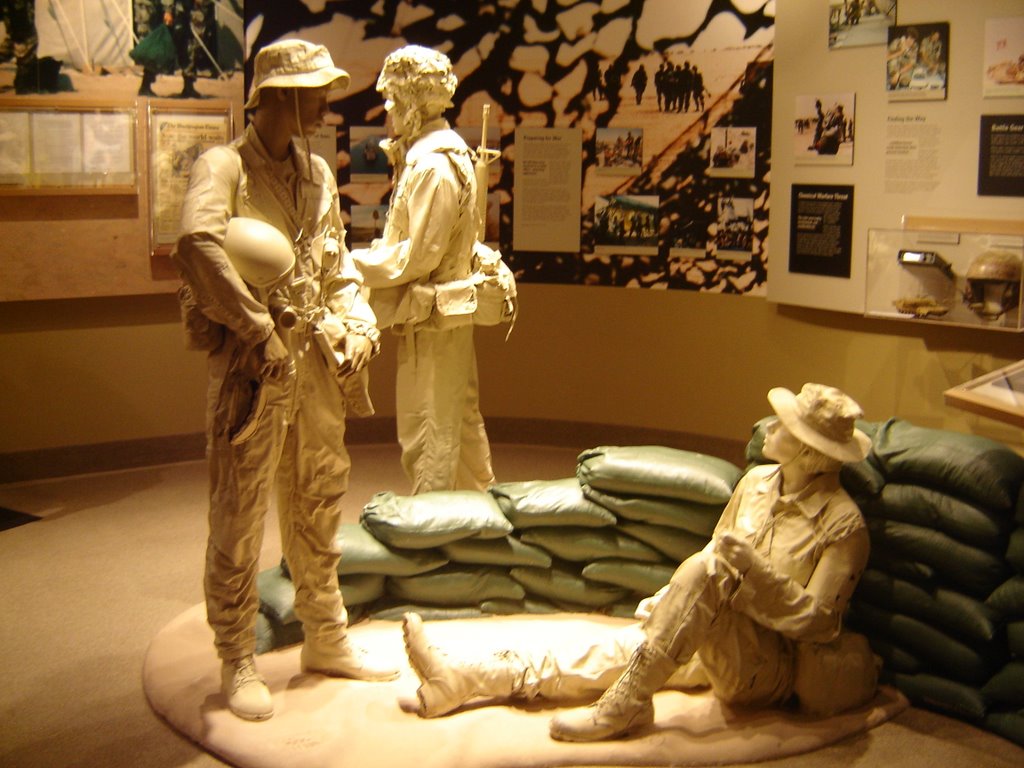
Bush's greatest accomplishment was undoubtedly his leadership during the Gulf War, when America's faith in its military might was restored. Bush helped put together an impressive military coalition that included a wide variety of nations and religious affiliations, along with 425,000 American troops.
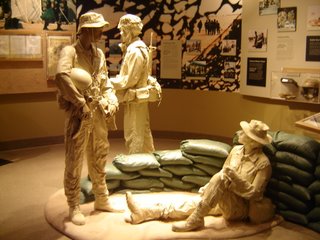
The Gulf War is given a lot of attention in the museum. It was his greatest realization of his vision of a "New World Order" of international law and global consensus.
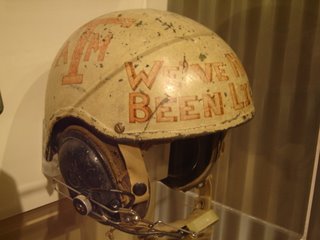
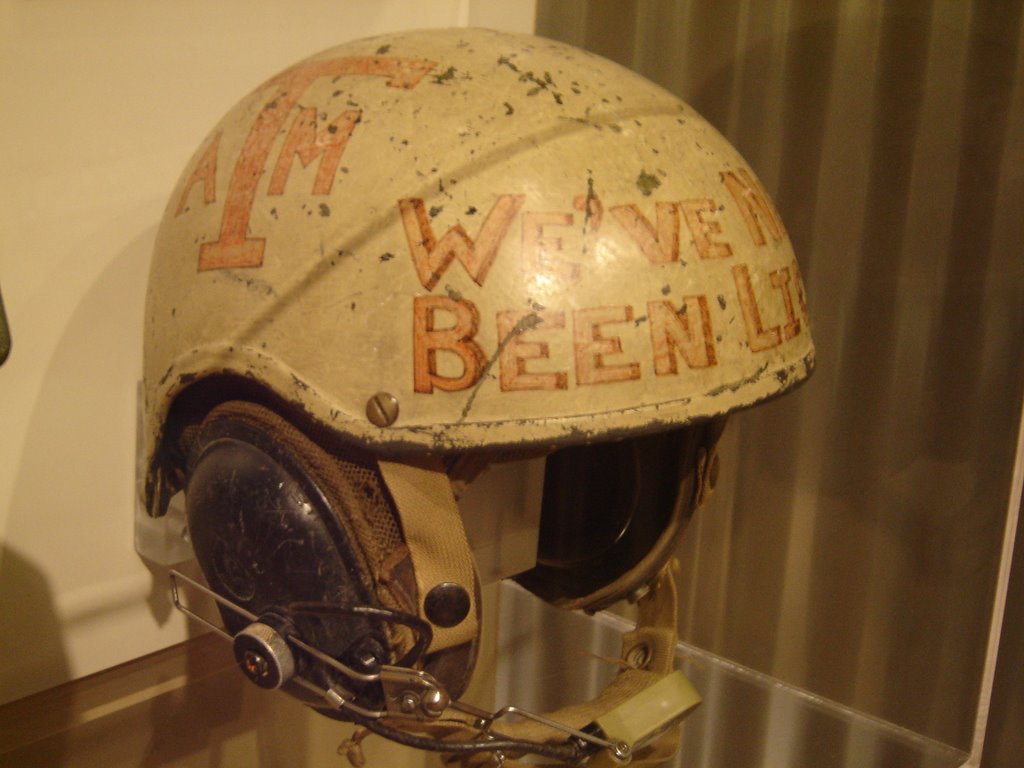
This helmet, worn by Lt. Michael A. Kelley, has a Texas A&M Aggie logo painted on his helmet.
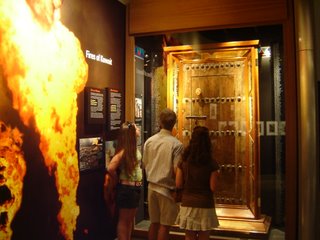
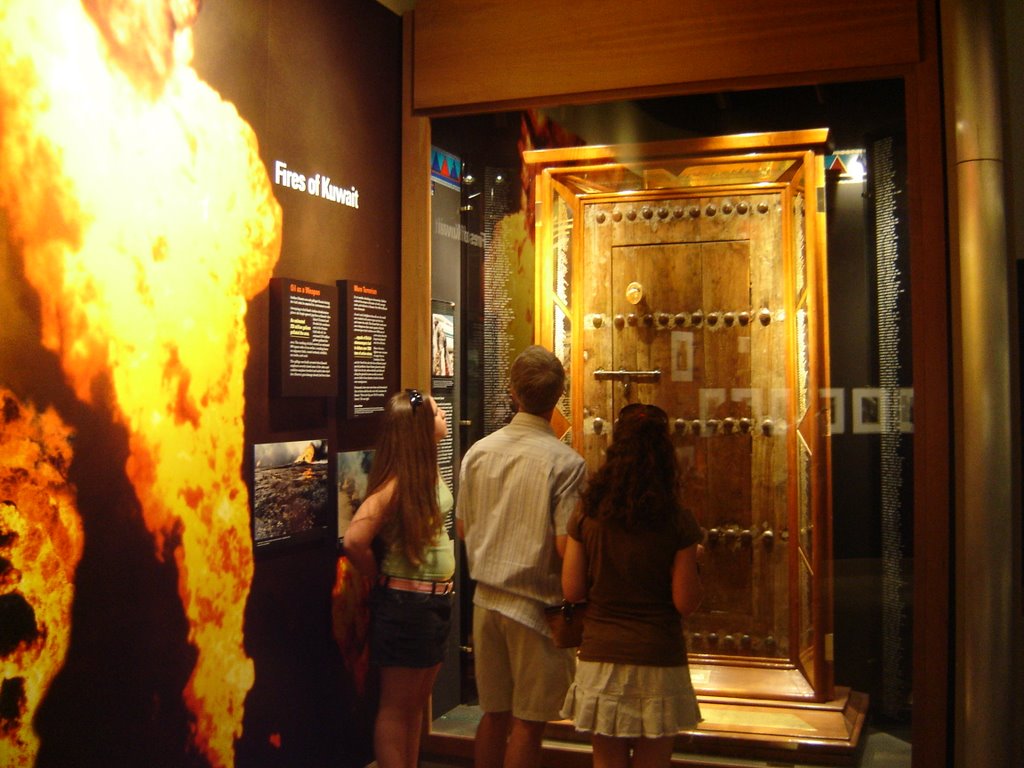
In a fitting display of the gratitude of the nation of Kuwait, and the sacrifice made by U.S. soldiers, engraved in a "Gate of Kuwait" are the names of U.S. military personnel who died in the war.
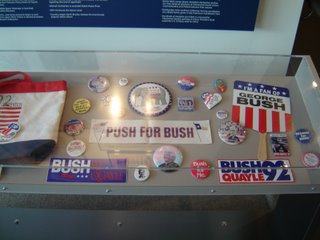
The Gulf War and Bush's foreign policy would not be enough for the President to win re-election. The museum points out that a recession from 1991 to early 1992 led to corporate layoffs and a nervous American public. The recession would be over and economic growth would hit 4.3 percent on election day, but not enough people believed it. Bill Clinton would win 43 percent of the vote and become president of the United States. The library does not mention Bush's campaign promise of "read my lips, no new taxes" and his 1990 compromise with Democrats to break it.
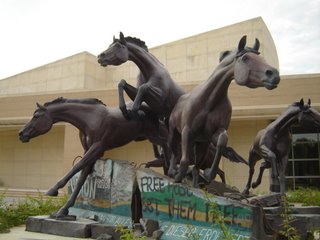
Just outside the library is "The Day The Wall Came Down," by Veryl Goodnight, which is inspired by the fall of the Berlin Wall.
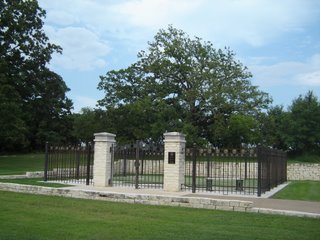
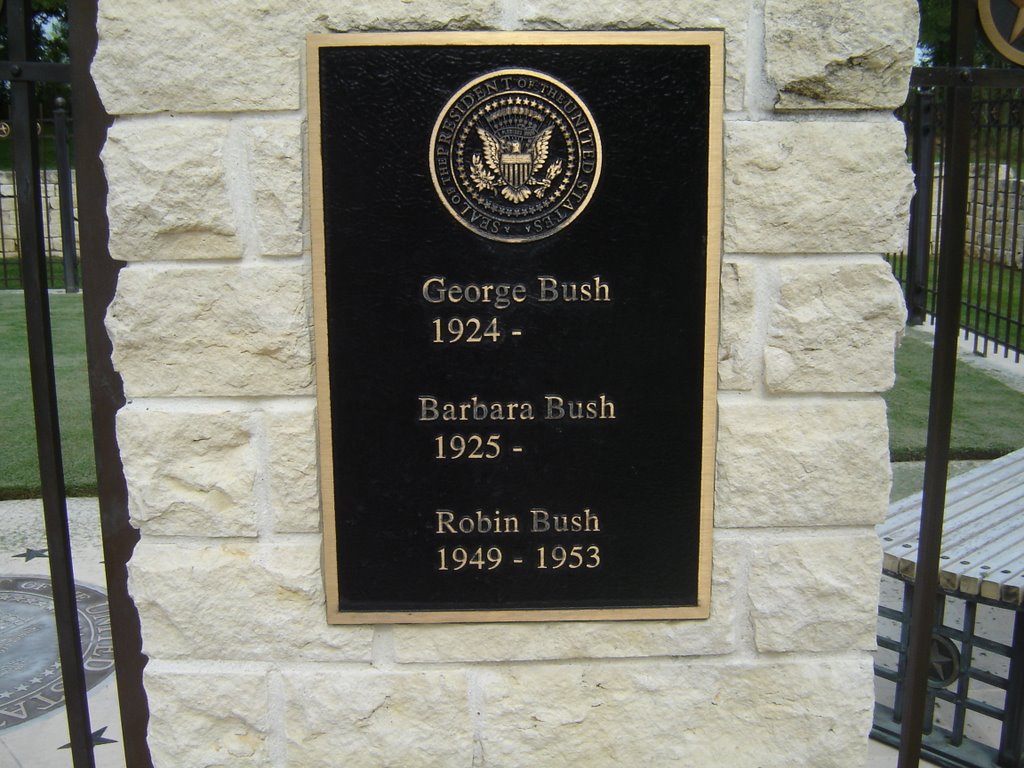
Nearby, the future gravesite of the former President and First Lady sits.
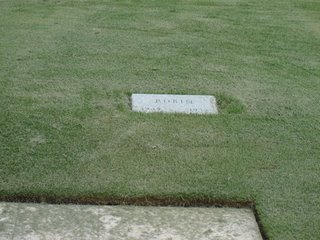
The only actual grave at the site currently belongs to Robin Bush, the current President's sister, who died at an early age.
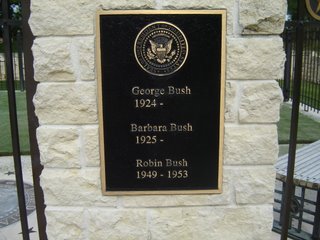
However, the sign is there and it appears it's only a matter of time until the Bush family rests here.
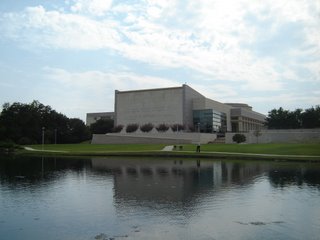
It is a fantastic library, and is up there with the LBJ museum in Austin, TX. It's only seven dollars, just one more than Herbert Hoover's. This one is a lot better. If you're in Aggieland, do check it out.

RELATED LINKS:
President George H.W. Bush's offical White House biography.

The Wikipedia biography of George H.W. Bush

Wikipedia: George Bush Library

Wednesday, June 28, 2006

How 'Bout Them Cowboys?

Today I toured Texas Stadium, home of the Dallas Cowboys. I even wore a blue shirt out of respect, although it was a team U.S. soccer t-shirt.

Texas Stadium, located in the Dallas suburb of Irving, TX, opened its doors in 1971. It cost $35 million to build, which is equal to the contract Deion Sanders got when he officially joined the Cowboys on September 9, 1995.

The tour begins in a luxury box suite. Cowboys owner Jerry Jones used luxury boxes as a way around revenue sharing to make his team one of the most profitable in the league. It allowed him to sign players for huge signing bonuses prior to the NFL salary cap that fueled the team to three Super Bowl titles in the 1990s. For just $35,000, you can get a 10 seat luxury box for an entire season. It's only $4,900 if you'd like to go to just one game. It costs more for larger suites. It does come with a nice view of the game.

There is also a banquet hall on the premises. It comes with a pretty good view as well.

You can see the names of Cowboy greats listed in the stands.

When the sales pitch ended, the fun stuff of the tour began. We got to tour the Cowboys locker room. Since it is off-season, they were mostly empty.

They had Roy Williams' locker mocked up so you could see what they tend to look like.

In the old days of coach Tom Landry, all players names were written in chalk. If Landry came over and wiped it off, it meant you were cut.

Here's QB Drew Bledsoe's locker. I have a lot of respect for Bledsoe, a former Buffalo Bill, although that didn't stop me from lampooning him here a couple of seasons ago. He seems to be a great guy though.

Next, we got to walk down the tunnel that the players use to get to the field.

The players are reminded of past glory each time they walk past it.

Each time the Cowboys won Super Bowls, it's mentioned here.

Even the ones they beat the Buffalo Bills in. This was a hard pill to swallow, but I moved on.

The best part of the tour, however, was getting to play on the field. Because the preseason was in full swing when I visited Lambeau Field, I did not get the chance to do it in Green Bay. I did, in 1984, rush onto the Shea Stadium's field after the last game the "New York" Jets ever played in New York City. I grabbed a patch of grass an planted it in front of my apartment building. This marked the first time I walked onto an NFL field with permission.

The Cowboys use artificial turf, and it's hard as a rock. When I walked onto the Kansas City Chiefs practice field a couple of weeks ago, it was much softer. I can see how this kind of material ends careers.

They gave us time to throw around footballs and kick field goals.

It was the highlight of the tour and one of the best times I've had in a while. I was totally a kid again.
I even paid proper respect to the Dallas Cowboy star.

Texas Stadium has a unique design. The fans, for the most part, stay in the shade. The players still have to deal with the elements. That's the design. Although any Cowboy fan will tell you why there's a hole in the roof of Texas Stadium: "so God could see the Cowboys play."

The Cowboys have a real home field advantage here. The home team decides which side of the field the away team uses, and what kind of uniform they can wear. In the early part of the season, the Cowboys always wear white (thus, the away team must wear darker colors) and sit on the shady sideline (the away team is in the hot sun). Just being on the field for a few minutes made me realize just what kind of an advantage that is. Texas can get really hot.

From the field you get a good look at the glory of Cowboys past...Super Bowl banners.

Soon after, we walked up the stands to end the tour.

Unfortunately, Texas Stadium is falling apart, and a new stadium is being built. I believe this is a chunk of the roof of the stadium. Pieces of it are all over the place.

Here's a section of the roof, and it doesn't look too good.

A big Dallas Star and a statue of Tom Landry greets you as you enter the stadium.

Landry was the team's first coach and led them to two Super Bowl titles.

Wow, what a fantastic tour. It was so much fun that I think I'll hate the Cowboys just a little less. Take advantage of it while you can, the Cowboys will not be playing there much longer.

Dallas, TX

One great thing about traveling all the time is that you get to see people you've lost touch with. This is a photo of Jennifer and I. We once worked together at Edelman (formerly Edelman PR Worldwide) a few years ago. It was nice to catch up.

Here are a couple of quick shots of the Dallas Skyline. I really didn't do much in the city other than see where JFK got shot and view Texas Stadium in nearby Irving, TX. If I have some more time someday, perhaps I'll check out what the city has to offer.

All I have to say though about this place right now is that people in Dallas are very dangerous drivers. It is one of the top three worst cities for driving stupidity, joining Los Angeles and Houston, TX.

Tuesday, June 27, 2006

JFK Has Been Shot!

Perhaps the most monumental thing ever to happen in Dallas, TX is the assassination of President John F. Kennedy on November 22, 1963. The site has turned into a tourist attraction for history and conspiracy buffs, as you can easily walk to the location where JFK was killed.

Two white "X" marks identify the estimated spots where bullets hit the former President (they are difficult to see here, but if you look at the lower center of the photo, right by the left traffic line, you'll see one of them).

There is no zig-zag paint for the magic bullet though, which was kind of disappointing.

The famous grassy knoll is there as well, and you can walk right up to it. This is fence where (possibly) a gunman (or two, or three, or seventeen) fired shots at the president.

This is the view from the grassy knoll. As you can tell, it's much closer to the "X" where the fatal blow hit Kennedy than the Texas Book Depository Building (although I did use a slight zoom lens for this photo, but probably to the same degree as I did when taking a picture from the "X" to the Book Depository Building).

In contrast, here is the view from the Book Depository Building, now the location of the Sixth Floor Museum that discussed the day in question. The location of the shots hitting Kennedy are in two points of the centered part of the road. On the top right you can see the fence where shots may have been fired from.

It defies logic that a gunman would miss from the grassy knoll (as the government now believes) and that another, from the this distance, would hit two out of three from such a location.

This is why most Americans do not believe that Lee Harvey Oswald killed Kennedy. Right next to the fence, there are a handful of people promoting conspiracy theories, like this man (who I believe identified himself as Mike, or Fred Brown) who says he was there (at the age of 12) when Kennedy was killed. He gives a very interesting and entertaining case for the U.S. government's involvement in the JFK assassination. Then he offers to sell you a magazine for $10 that gives you more information.

Later on I would see a list of eye witnesses from that day and there was no Mike or Fred Brown listed. It's possible that I got his name wrong, or perhaps the powers that be have eliminated all record of him (if this website is shut down for no reason, you now know why...).

Some people have used the space to pay their respects to the fallen president in the form of graffiti on the fence where shots may have been fired.

Others have used it to promote conspiracy theories: like one that says the FBI killed JFK.

An then there are some people who used it to make sure everyone in the city knew that the Miami Heat beat the Dallas Mavericks for the 2006 NBA title. Some wounds may never heal.

Soon after, I would find definitive photographic proof that someone who looked really mean was at the grassy knoll. The conspiracy is solved! Maybe Mike/Fred Brown was right!

There are two main stories when it comes to the JFK assassination: 1) Lee Harvey Oswald did it (a.k.a. the "official" story, and 2) the government, the mafia, al Queda, O.J. Simpson and Saddam Hussein did it.

In what was once the Texas Book Depository Building is the Sixth Floor Museum, which promotes the former President's life and official version of his death.

In the museum, you will find various photographs about Kennedy and his assassination.

In anticipation of President Kennedy's visit, thousands of people lined the streets to view his motorcade. More than 75 amateur and professional photographers took over 500 exposures in and around Dealey Plaza. It turns out that this would be a defining moment of network television news, launching the career of famous liberals like Dan Rather to national notoriety.

It would also give enough fodder/evidence of a conspiracy that would captivate us 40 years later.

The Sixth Floor Museum spends quite a bit of time on the Kennedy Presidency, establishing the context of his death and the effect it had on our nation.

The motorcade arrived in Dealey Plaza and then turned right from Main to Houston Street. If a lone gunman sitting on the sixth floor of the Book Depository Building was to fire a weapon at the President, this was the street to do it on. He would have had two or three head on shots at relatively close range. Instead, shots were fired seconds after Kennedy's car made a 120 degree turn into Elm Street passing Oswald's supposed location.


When the limousine had passed the depository, shots were fired at JFK for an estimated time span of 6 to 24 seconds. During the shooting, the limousine is believed to have slowed from over 13 mph to only 9 mph.

This is where Oswald is believed to have fired the shots that killed Kennedy. The Warren Commissionnoted that three empty shells were found in this room in the then Book Depository Building. A rifle identified as the one used in the shooting -- Oswald's Italian military surplus 6.5x52 mm Model 91/38 Carcano -- was found hidden nearby.

From the Sixth Floor Museum, you can see where the President was shot. You can also see why it seems unlikely that a gunman would have waited for JFK to get to this spot to shoot him, when better options had existed before.

After Kennedy was dead, security for the new President Johnson was an issue. Johnson did not want to leave without Jackie Kennedy who would not leave without her husband. In spite of Secret Service pressure to get to the safety of Air Force One, Johnson said, "I will not leave without President and Mrs.. Kennedy." As a compromise, it was decided Johnson could wait for the Kennedys on board Air Force One and so he was evacuated from Parkland Hospital.

This helped fuel a controversy that still exists today. No autopsy was performed on Kennedy, as per Texas State law at the time.

Nearby the Sixth Floor Museum is the Consipracy Museum, where theories on the assassinations of JFK, his brother Robert Kennedy, and Martin Luther King, Jr. are explored.

This represents a hodge podge of "the government did it" stories. There's even a conspiracy tree.

Competing theories of the JFK assassination are discussed. In this scenario, nine shots are believed to have been fired from two points at the Book Depository Building, another from the next block, and more from the grassy knoll. Even the museum staff attendant thought this one was "a waste of canvas", but R.B. Cutler, the author of this idea, was the place's co-founder and therefore his theory was included.

A Warren Report display shows here that three shots were fired, all by Oswald from the Book Depository Building. The two red lines indicated hits, the third blue one a miss.

The Warren Report would make diagrams of the damage to Kennedy's head. These replicas show where the bullets hit and what damage they did.

Believe it or not, it is in dispute where exactly in Kennedy's body the first bullet hit him. This photo of Kennedy's shirt seems to contradict the Warren Report on the entry wound of the first bullet. Nothing, not even some of the smallest facts, seem to be in agreement. Years later, then future President Gerald Ford would admit to changing a sentence in the report about this information.

The Warren Report would propose what is now known as the Single Bullet Theory, created by now U.S. Senator Arlen Specter. This is how the bullet supposedly hit both Kennedy and then Texas-Governor John Connally. A top-side view of the theory may be found here.

Fifteen years after the Warren Commission report, the House Select Committee on Assassinations came up with a theory, based primarily on dictabelt evidence, that President Kennedy was assassinated possibly as a result of a conspiracy.

They proposed that four shots had been fired during the assassination; Oswald fired the first, second, and fourth bullets from the Book Depository Building. Acoustic evidence suggested that there was a high probability that a second assassin in the grassy knoll fired a third bullet but missed. The diagram above shows that theory.

My photos above, showing the relative distances of the grassy knoll and the Book Depository Building, make it very hard for me to believe. But that is the official story, according to the U.S. government and its many experts.

Dr. Robert Nelson McClelland, was one of the doctors that treated President Kennedy in the emergency room in Dallas. Dr. McClelland testified to the Warren Commission and the Assassination Records Review Board. He approved a sketch of the head wound (click on the link to find a copy of it). The new committee had another diagram of the head wound created, which is above.

This chart sums everything up. This is a description of everyone who had a hand in killing JFK. It's so complicated that I can't figure it out. What a great conspiracy! It's good museum fodder.

James Tague is believed by some to be a third man injured due to the Kennedy Assassination. Most people believe that it was a stray fragment of a bullet. Others believe Osama Bin Ladin shot him. The Conspiracy Museum has this board talking about his experience.

Then there's the three hobos, or homeless men that were detained shortly after the assassination. One of them looks like Charles Voyde Harrelson, actor Woody Harrelson's father. By the late 1970s, other researchers have identified at least five of the three, well at least they think they did. The tramps may include Thomas Vallee, Frank Sturgis, Daniel Carswell, E. Howard Hunt or Fred Chrisman. What does this mean? I have no idea.

A diagram of the Martin Luther King, Jr. assassination was created as well.

The Robert F. Kennedy assassination was part of the committee's study too. There seems to be a conspiracy about this as well.

Wikipedia tells us:
Just before the 1964 presidential election, President Johnson ordered the Warren Commission documentations to be sealed against public availability for 75 years (until 2039). However, in 1992 Congress enacted the President John F. Kennedy Assassination Records Collection Act of 1992. Congress questioned the legitimate need for continued protection of such records, after three decades of secrecy. The purpose of the Act was to gather and accelerate the public release of assassination related documents.

The Act requires all documents related to the assassination that have not been destroyed to be released to the public by no later than 2017.
Today, hundreds of foreign streets bear John F. Kennedy's name. There are 27 in Greece alone. Go Greece!

This was a fantastic day. I learned so much. I learned that...I have no idea what. Kennedy may have been killed in a massive conspiracy, or he may have tripped over a banana peel. We will never know, but historians will likely search for clues long after I've passed away.

If you are a history buff, however, you really should see things for yourself. You probably will not come out of it with any answers though. It's doubtful anyone ever will.


RELATED LINKS:
Information on the Kennedy Assassination

JFK Assassination Research Materials


Bogus Information on the JFK Assassination

The context of the JFK Assassination

Wikipedia on the Assasination of John F. Kennedy

The President John F. Kennedy Assassination Records Collection -- the official government database

Graphic photos of the Kennedy Assassination.

JFK Autopsy Photos

Sunday, June 25, 2006

Des Moines, IA

I spent a week in Clive, IA, right by Des Moines. It was a fairly lazy time, as I needed some rest and relaxation. Here are some random photos of things I saw while hanging around there. Des Moines offers many things, including breathtaking sunsets.

Apparently, people are Minnesota Vikings fans here.

They really don't like the Green Bay Packers.

It began to rain during the Des Moines Art Festival, leading to this photo.

Here is the state capitol.

This is the downtown area. It was a nice city. It proved to be a nice place to relax.

Saturday, June 24, 2006

Photo Essay: Des Moines Art Festival

Today I went to the Des Moines Art Festival in Iowa, featuring 150 carefully selected artists. Last year 230,000 people attended the three day affair. The festival is ranked third among 600 fine arts festivals nationwide. Below are works of art I found interesting, with website links to the artists (if I could find them). Buy their stuff!

It as a well attended affair.

"You May Already Be A Weiner," by Jerry Berta.

Here's me in between "Egghead" ($5,800) and "C'Est La Vie" ($7,000) by Kimber Fiebiger. I'm not included in the price.

"Jester Fountain" ($12,000) by Kimber Fiebiger.

Brian Olsen's Art In Action show was on hand. Olsen would throw paint on the canvas and a famous image would come out.

He did this was to various Willie Nelson tunes.

He attracted a huge crowd.

"Reclaiming The Sacred Lost: Bridget" ($5,500) by Lynn Creighton. Creighton's face is inside the sculpture.

A work by Randall Reimer that won best of metal works.

Kim and Cliff Erickson of Erickson Art Glass.

Ron Schmidt of Tesquesta, FL.

Work by Toby McGee of Oklahoma City, OK.

Steven Olszewski of Pinckney, MI.

Tony Cray from New Melle, MO.

Bruce Niemi of Knosha, WI.

Various works by Mary Miller of Vandalia, IL.

Thomas Sheehan of Oak Park, IL.

Various work by Tom Radca of Port Washington, OH.

Suzy Scarborough, who has an amazing ability to paint eyes with expression.

Andrew Carson of Kinetic Sculpture.

More by Andrew Carson of Kinetic Sculpture.

Kimber Fiebiger of Minneapolis, MN.

Nicario Jimenez of the Andes won best of show due to 3-D wood images like these. They were spectacular.

A very frighteningly real sculpture by Marc Sijan.

Here's a real person (right) with a fake person (left) created by Marc Sijan.

More by Marc Sijan.

The hottest woman at the whole art festival was a sculpture by Marc Sijan. I asked her out but she gave me the cold shoulder. The cop is a sculpture too.

Larry Fox of Omena, MI.

Here's me participating in live art! I was holding onto string while other people did it too. Fun!

It was a great event. Art is kool man!

Friday, June 23, 2006

Herbert Hoover Presidential Library & Museum

Today I made a long drive from Des Moines to West Branch, IA to see the Herbert Hoover Presidential Library & Museum. Hoover was Iowa's only President. Other than the fact that Hoover has a dam and a public interest group named after him, I knew very little about the 31st President of the United States.

With a $6 price of admission, this is the cheapest of the Presidential libraries I've been to, which include FDR's, Truman's, Johnson's, Carter's, and Reagan's.

The Museum would cover his life and times. Herbert Hoover began with relatively humble beginnings, being the son of a blacksmith and businessman.

Both of Hoover's parents would die when he was a very young man. He would go on to live with his Aunt Millie and Uncle Allan Hoover on a farm near this location. Raised in the Quaker tradition, Hoover would read this Bible on a daily basis.

Hoover would move to Oregon when he was 11 to live with his uncle, Dr. Henry John Minthorn.

He eventually went to Stanford University in Palo Alto, joining the school's first class. He graduated in 1895 with a degree in geology and without any job prospects. Eventually, he got a job in the California gold mines shoveling ore in Nevada City.

He became a mining engineer and that took him to some interesting locations, like Australia in 1897, a job in which he lied about his age to get. He would be very successful at this job, eventually getting a raise to $10,000 a year!

Mining equipment from this time period is on display.

On February 10, 1899, Hoover married Lou Henry, whom he had met at Stanford. Before you think that Hoover was a really liberal guy, Lou was a woman (an impressive one too, she was the first one to graduate from the school with a geology degree). Artifacts from the wedding are on display.

They left immediately for China, where Hoover continued his career. In 1900, they survived the Boxer Rebellion, an uprising of Chinese nationalists calling itself "I Ho Tuan". Hoover's village, Tientsen, eventually became under siege, as bullets flew near their home.

At one point, an artillery shell hit their dwelling place (fragments of that shell are on display above). Shortly thereafter, Lou Hoover would read her own obituary. Eventually, U.S. Marines would rescue the Hoovers and other Americans nearby.

Hoover became a partner in Bewick, Moreing and Co. in 1901. He would travel the globe with his job, and made a considerable amount of money. Hoover retired from the company in 1908 and established his own international firm of engineering consultants based in London. This German pin helmet is an example of the places he saw and the cultures he interacted with.

Around 1914, war was brewing and international affairs became more complicated and violent. As a self-made millionaire by age 40, Hoover was in a unique position to help. Having been raised in the Quaker tradition, he is said to have believed in being "humane and generous to others". His life would change considerably at this time.

Around this time he began to help Americans stranded in Europe after the breakout of World War I and served as Chairman of Commission for Relief in Belgium, a country dependent on 80% of its food from imports that was then surrounded by British and German forces.

In 1917, he came the United States Food Administrator for President Wilson. From 1918-19, he founded the Hoover Institution of War, Revolution, and Peace at Stanford University. It was a think tank dedicated to political affairs.

In 1919 he would attend the Versailles Peace Conference and have a life mask made of him. It's probably the oddest exhibit of any presidential library. The treaty worked out so well everyone decided to fight again a generation later.

The roaring twenties would take place, and the country transformed. The museum has a section on it.

From 1921-28, he served as Secretary of Commerce for Presidents Warren G. Harding and Calvin Coolidge.

Conveniences like irons became commonplace.

Washing machines! No more washing your clothes in the nearby river!

More importantly, Hoover helped set the rules and regulations for the cutting edge of mass communication systems: like terrestrial radio.

In 1928, Coolidge decided he would not run for another term. With Hoover being extremely popular, he was the clear candidate to run under the banner of the Republican party.

Hoover would dominate New York Democrat Alfred E. Smith, the first Catholic to get a major party nomination. Being Catholic was a liability for Smith (it still is today), as opponents spread rumors that the Pope would run the country if he got elected.

As a popular reformer and visionary, Hoover was elected to very high expectations. This telegram of congratulations came from Thomas Edison.

He was elected President of the United States to very high expectations. He practices a "Good Neighbor Policy" towards Latin America (a phrase made famous by FDR) and withdrew troops from Haiti and Nicaragua. He and former Secretary of State Henry Stimson negotiated a boarder dispute between Chile and Peru. He is also credited with signing the London Naval Treaty, reforming Federal courts, creating the Federal Farm Board and Veterans Administration, regulating stocks and securities, increasing acreage of national forests, and expanding the national park system.

On June 25, 1929, President Hoover signed the $165 million Boulder Canyon Project Act, which would become the Hoover Dam.

Oh yeah, and there was a little thing called the Great Depression. A stock market crash on October 29, 1929 -- where $30 billion of wealth disappeared -- triggered a time period of pain and disaster for America. The library positions him as doing more in this regard than any previous president, "paving the way for the anti-depression New Deal measures".

Between 1929 and 1933, America's economic output was cut in half. Nearly six thousand banks went under, taking $3 billion of uninsured dollars with them. The bond market suffered when the real estate boom went bust. The worst drought in U.S. history took place in an area the size of Europe. In 1932, unemployment reached over twelve million people, 23.6% of the population.

A sign at the museum says that Hoover's greatest failure was his "failure to dramatize himself," which seems odd in the context of a 23.6% unemployment rate. Now I know who President Hoover was...he was the guy in charge of a disaster.

Hoover's efforts were not enough. Hoover would be demolished by Franklin D. Roosevelt in the 1932 election, losing all but six states (including Iowa) and bringing in a Democratic majority that would last more than 50 years. Hoover was shocked and stunned by the loss.

In his final weeks as president, a banking crisis took place. Hoover had a suggested course of action, but wanted the president-elect to join with him on the solution. FDR balked on the idea, and Hoover's presidency ended in another failure. Shortly after assuming office, Roosevelt enacted the exact same policy that Hoover had suggested.

He had to repair his image in the years after his presidency, but eventually would serve as an elder statesman, and is credited (by the museum) as defining the modern post-presidency. He would do things like meet with Hitler and try to convince America not to get into World War II. Man, even after he left office he seemed on the wrong side of history. Why would the museum put up a photo with him and Hitler? Are they trying to get us to hate the guy?

After his wife's death, Hoover would move to New York and open up an office.

Here is a replica of his Manhattan office. It was at this point that I realized that there would be no replica of the Oval Office, a staple of the Presidential library system. Man, Hoover must have been bitter about his experience.

A piece of the Berlin Wall is on display. Hoover would not see the end of the Cold War, as he would die on October 20, 1964.

The museum had a temporary exhibit on the 1960s. It consisted mostly of photos, clothes, and music from the decade.

The grounds have other sites, like a schoolhouse and his birthplace.

But the site to see is the burial site of Hoover and his wife. It was simple and appropriate for a humble man who did his best.

This is probably the most depressing of Presidential libraries, far surpassing the apologetic Jimmy Carter library in this regard. Hoover's legacy is not a good one, and seemed on the wrong side of history at every turn while president. He did seem to be a nice guy however, for whatever that is worth. But if we are truly to understand history, we must focus on our country's hard times, as it puts everything we have today in perspective.

In light of that, the trek to the Hoover library was well worth it.